Thinking Machines launches Inkling, a multimodal AI model
Thinking Machines has published Inkling on Hugging Face, an open model that understands text, images, and audio and supports up to 1 million context tokens. It has 975 billion parameters but requires hundreds of gigabytes of memory to run, so it will mainly be used on servers and through quantized versions.
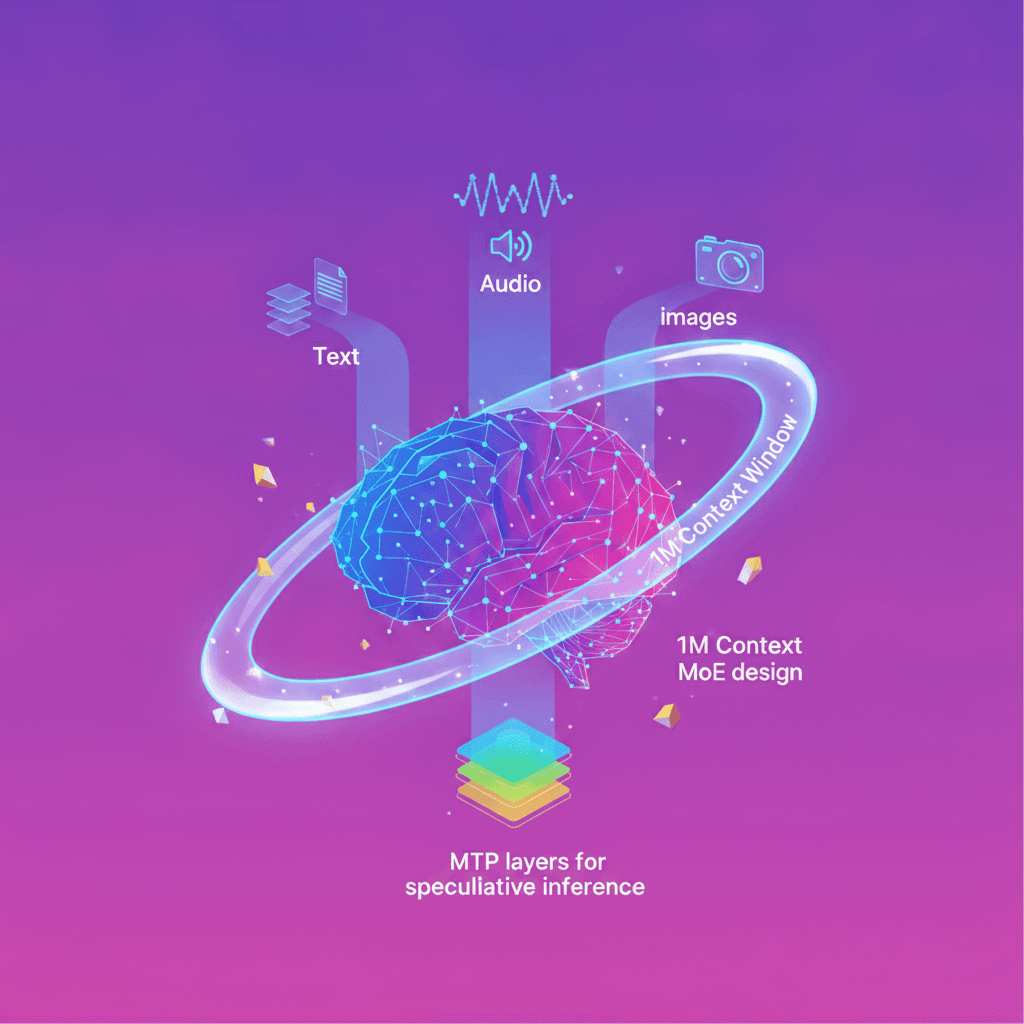
Thinking Machines has published Inkling on Hugging Face, an open AI model that can take text, images, and audio in the same conversation. Its context window reaches 1 million tokens, enough to work with very long documents or analyze large amounts of information without splitting them into as many parts.
The model has 975 billion parameters, although it activates only around 41 billion at each step thanks to an architecture called Mixture of Experts. In practice, this allows a huge model to avoid using all of its components to respond to every request.
Thinking Machines says Inkling was trained on 45 trillion tokens from text, images, audio, and video. Its main goal is to reason across modalities: for example, reading the label on a medication in an image, listening to an explanation, and responding based on both sources.
What Inkling can do
The model works as a flexible input and output system. It can analyze an image and answer questions about it, transcribe audio, or use any of that content as part of a reasoning task.
Some possible uses include:
- Extracting information from scanned documents and answering questions about them.
- Transcribing a recording and detecting relationships or errors in what is said.
- Analyzing charts, photographs, or screenshots.
- Creating agents that can use tools and work with files.
- Adapting to specific tasks through fine-tuning, meaning additional training with data from a particular industry or company.
The company has also designed the model to generate responses with different levels of reasoning effort. You can choose anything from a quick response to a longer analysis. In the internal tests shared by Thinking Machines, the medium level appeared to offer a balance between accuracy and token usage, although those evaluations do not replace an independent comparison.
A powerful model, but not for every computer
Inkling's main limitation is its size. The full version in BF16 format requires around 2 TB of video memory, while the compressed NVFP4 variant needs about 600 GB and is designed for newer Nvidia GPUs.
That means running it locally is beyond the reach of a conventional computer. You can try it through Hugging Face inference providers, and quantized versions for llama.cpp are also available that significantly reduce memory usage. A team at Unsloth says it has reduced the size by 95% with a 1-bit version, although with a loss of accuracy compared with the original model.
Inkling supports Transformers, SGLang, vLLM, and llama.cpp from day one. It also includes MTP layers, a system that predicts several tokens in advance to speed up generation without changing the final response when the speculative prediction is correct.
For you, this does not mean you can install it directly on a laptop. Its importance lies elsewhere: an open model combines text, images, and audio with a huge context window, and it can also be fine-tuned for specific tasks. What remains to be seen is whether that capability holds up in independent evaluations and how much it costs to use once it moves from demonstrations to real applications.