ServiceNow introduces Apriel-1.6, a multimodal AI model
ServiceNow introduces Apriel-1.6-15B-Thinker, a multimodal model with 15 billion parameters that scores 57 on the Artificial Analysis Index and competes with much larger systems. The new version reduces its reasoning tokens by more than 30% and improves its understanding of text, images, documents and charts.
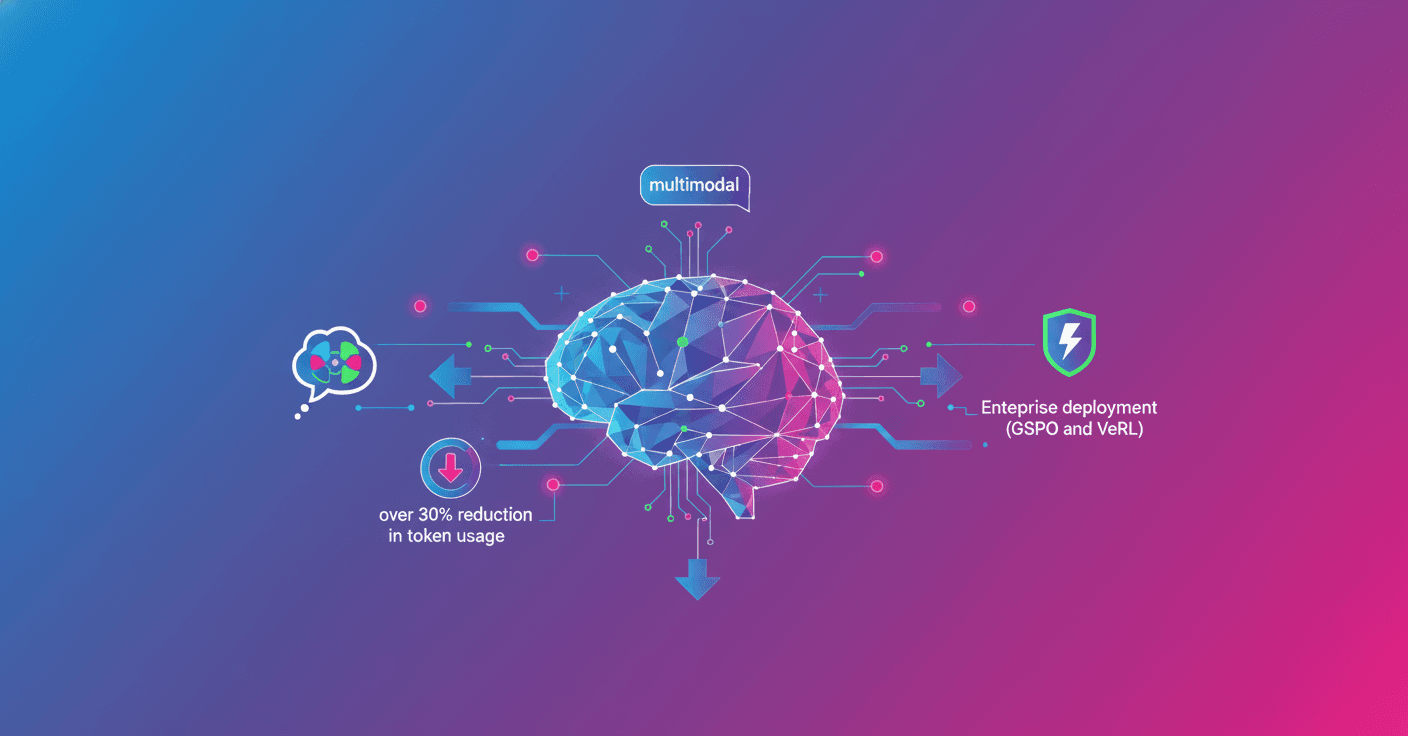
ServiceNow has introduced Apriel-1.6-15B-Thinker, a multimodal artificial intelligence model that understands text and images and aims to compete with much larger systems using a fraction of their resources. It has 15 billion parameters, yet scores 57 on the Artificial Analysis Index, according to the evaluations cited by the company.
That score puts it above models such as Gemini 2.5 Flash, Claude Haiku 4.5 and GPT OSS 20B on the index. It also matches Qwen3 235B A22B, which uses far more parameters. The comparison does not mean it wins at every task, but it does point to an important trend: smaller models can deliver competitive results when trained with better data and more efficient methods.
More capability with less reasoning
Apriel-1.6 builds on Apriel-1.5-15B-Thinker and maintains or improves its performance on the benchmark tests. The main improvement is efficiency: it reduces the number of tokens used for reasoning by more than 30%.
Tokens are the units a model uses to process text. Using fewer tokens usually means faster responses and lower resource consumption, especially when a system handles thousands or millions of queries. The model tries to devote more effort to difficult problems and respond directly to simple ones.
To achieve this, ServiceNow combined supervised training with reinforcement learning. The first used 2.4 million examples covering step-by-step reasoning, math and programming problems, tool calls, writing and instruction following. The second rewarded correct answers and penalized verbosity, incorrect formats and unnecessary steps.
It reads documents, charts and screenshots
The model is not limited to text. Its multimodal training includes document and chart understanding, optical character recognition, image-based questions, visual reasoning and code generation for web pages or SVG graphics.
In vision tests, ServiceNow says Apriel-1.6 improves by 4 points on average over the previous version across a set of 13 evaluations. These tests include image-based math problems, charts, diagrams, logic and questions about visual content.
In practice, this can help analyze a scanned invoice, extract information from a table, interpret a sales chart or answer questions about a document containing text and images. It is also designed for business tasks such as tool use and function calls.
A model designed to deploy with fewer resources
Training the intermediate phase required around 10,000 GPU hours on NVIDIA GB200 chips. ServiceNow presents this as evidence that a careful data and training strategy can produce capable models without the scale of the largest AI labs.
That does not mean the model is cheap or lightweight on every device. Fifteen billion parameters still require specialized hardware to run quickly, especially when processing images or performing long reasoning sequences. Its advantage is that it may be easier to deploy and operate than a system with hundreds of billions of parameters.
It also has clear limitations: complex or low-quality images can reduce OCR accuracy, dense scenes make it harder to count objects, and highly detailed charts can be misinterpreted. Precisely locating elements within an image is not always reliable either.
Apriel-1.6 shows that the AI race does not depend only on building ever-larger models. The next thing to watch will be whether its performance holds up in real applications, with enterprise data and specific operating costs, rather than only in laboratory tests.