OpenAI launches GPT-5.6 with three AI models
OpenAI launches GPT-5.6 with three models, Sol, Terra and Luna, available in ChatGPT, Codex and the API. The family adds agent coordination, programmatic tool use and improvements in programming, professional work and cybersecurity, with prices starting at $1 per million input tokens.
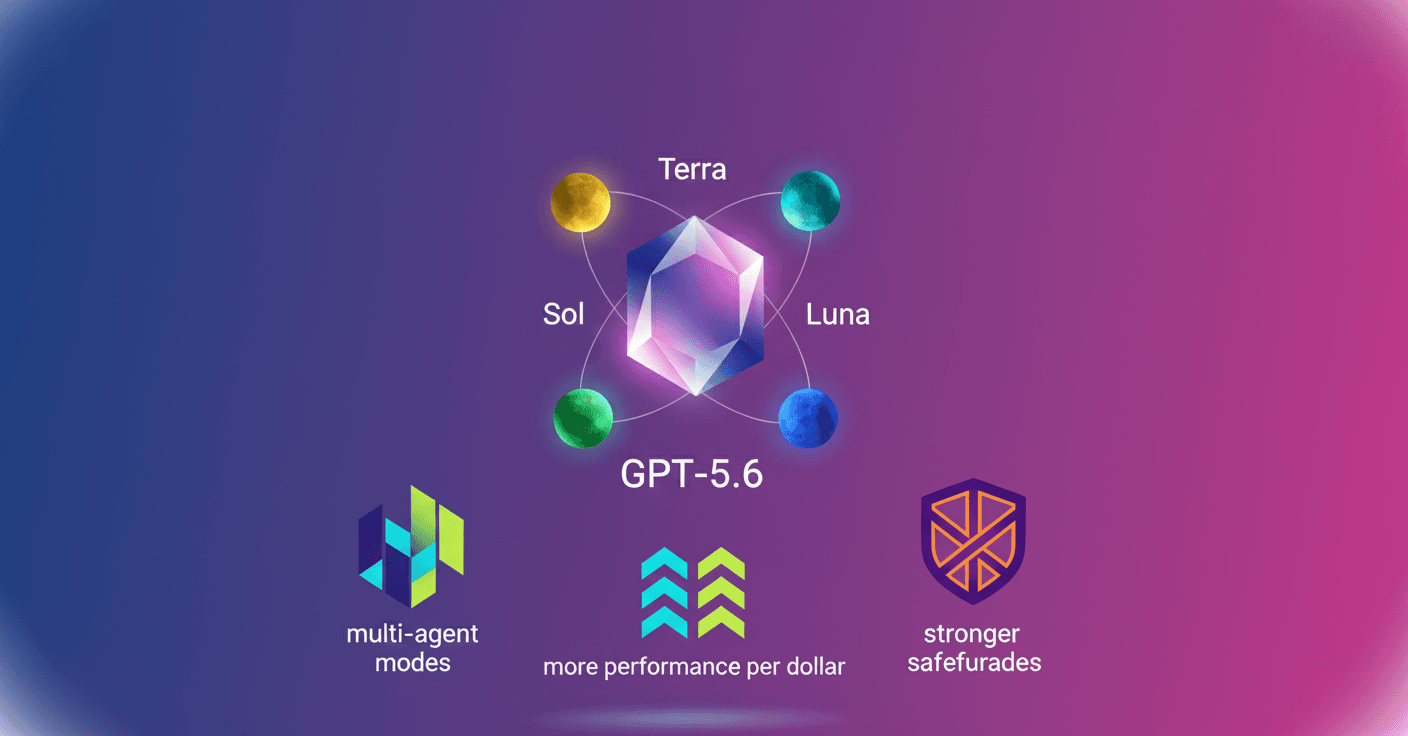
OpenAI is now making GPT-5.6 generally available across ChatGPT, Codex and its API. The new family includes three models, Sol, Terra and Luna, along with features for coordinating agents, using tools and completing professional tasks in less time and at a lower estimated cost.
The rollout began on July 9, 2026, and will gradually expand to all users over the following 24 hours. Availability depends on your plan and the product you use.
Three models for different levels of work
GPT-5.6 is not a single model. OpenAI divides it into three tiers:
- Sol: the most capable model, designed for programming, analysis, science, cybersecurity and complex tasks.
- Terra: a balanced option for everyday work, with performance close to GPT-5.5 at a lower cost.
- Luna: the fastest and most affordable model, designed for frequent, high-volume tasks.
In the API, prices per million tokens are $5 for input and $30 for output for Sol, $2.50 and $15 for Terra, and $1 and $6 for Luna. Tokens are the units the model uses to process text, so the final cost depends on how much context it receives and how much it generates.
OpenAI is also introducing more predictable caching. Stored inputs kept for reuse are charged at 1.25 times the standard rate, while cache reads retain a 90% discount.
More capacity for long tasks
The main change is not simply that the model responds better. It can organize work differently. The ultra mode coordinates four agents in parallel by default. Each one works on part of the problem, and the system then combines the results.
For example, a company could ask it to review a financial report, check its figures, compare the data with external documents and prepare a presentation. Instead of completing each step one after another, the agents can divide up part of the work.
The mode uses more tokens, so it is not designed for simple questions. Its goal is to reduce the time needed for tasks that require research, verification and several rounds of review. In ChatGPT Work, it is available for Pro and Enterprise plans, and in Codex for Plus plans and above.
The API also includes Programmatic Tool Calling. With this feature, GPT-5.6 can write small in-memory programs to coordinate tools, filter large amounts of data and decide what to do next. That avoids sending every intermediate result back to the model and can reduce costs, interaction rounds and manual oversight.
What the tests show
OpenAI says GPT-5.6 Sol outperforms GPT-5.5 and several competing models across different evaluations, although the results depend on the reasoning mode, tool use and configuration of each test.
In programming, Sol scores 80 points on the Artificial Analysis Coding Agent Index, compared with 76.4 for GPT-5.5. It also achieves 88.8% on Terminal-Bench 2.1, a test of complex command-line tasks. In ultra mode, it reaches 91.9% on the same evaluation.
In computer use, Sol scores 62.6% on OSWorld 2.0, compared with 47.5% for GPT-5.5. On BrowseComp, a web research test, it reaches 90.4% in its standard configuration and 92.2% with ultra.
The family also improves in cybersecurity. Sol scores 71.2% on SEC-Bench Pro, compared with 45.8% for GPT-5.5, and 73.5% on ExploitBench, compared with 47.9%. These tests measure specific technical capabilities and do not mean that the model can reliably carry out autonomous attacks against protected targets.
OpenAI also says Sol creates better presentations, documents and spreadsheets. It can analyze an existing template, identify its fonts, colors, layout and design rules, and apply that structure to new content. In practice, this is meant to reduce the work of correcting automatically generated slides or reports.
More controls for high-risk uses
GPT-5.6 comes with stricter oversight in cybersecurity and biology. OpenAI combined automated testing, external evaluation teams and nearly 700,000 hours of A100e GPU automated testing to look for failures and ways to bypass restrictions.
The company says the model is more useful for finding and fixing vulnerabilities than for carrying out full attacks against hardened systems. The most advanced defensive capabilities are reserved for verified users through the Trusted Access for Cyber program.
This approach may lead to more blocks on legitimate tasks. OpenAI says Sol's safeguards block approximately ten times more potentially harmful activity than those of earlier models, although it acknowledges that it will keep adjusting them to reduce false positives.
What changes for you
Plus, Pro, Business and Enterprise users can access GPT-5.6 Sol in ChatGPT with medium or higher effort levels. Pro and Enterprise users can also select Sol Pro for complex work. Free and Go users receive Terra in ChatGPT Work and Codex, while higher-tier plans can choose between Sol, Terra and Luna depending on the product.
For everyday use, the most visible difference will be the quality of documents, presentations, analysis and tasks that require multiple tools. For developers, the important change is that the model can coordinate those steps more effectively on its own and do so with fewer API calls.
GPT-5.6 also shows that competition is no longer focused only on who gets the highest score. Cost, response time, the ability to work with programs and the option to divide a task among several agents are just as important. What remains to be seen is how much of these improvements holds up in real work, where data, instructions and tool errors can significantly change the result.