OpenAI launches GPT-5.4 mini and nano AI models
OpenAI introduces GPT-5.4 mini and nano, two AI models designed for fast, high-volume tasks. Mini outperforms GPT-5 mini in coding, reasoning and tool use, while nano cuts costs further for classification, data extraction and simple tasks.
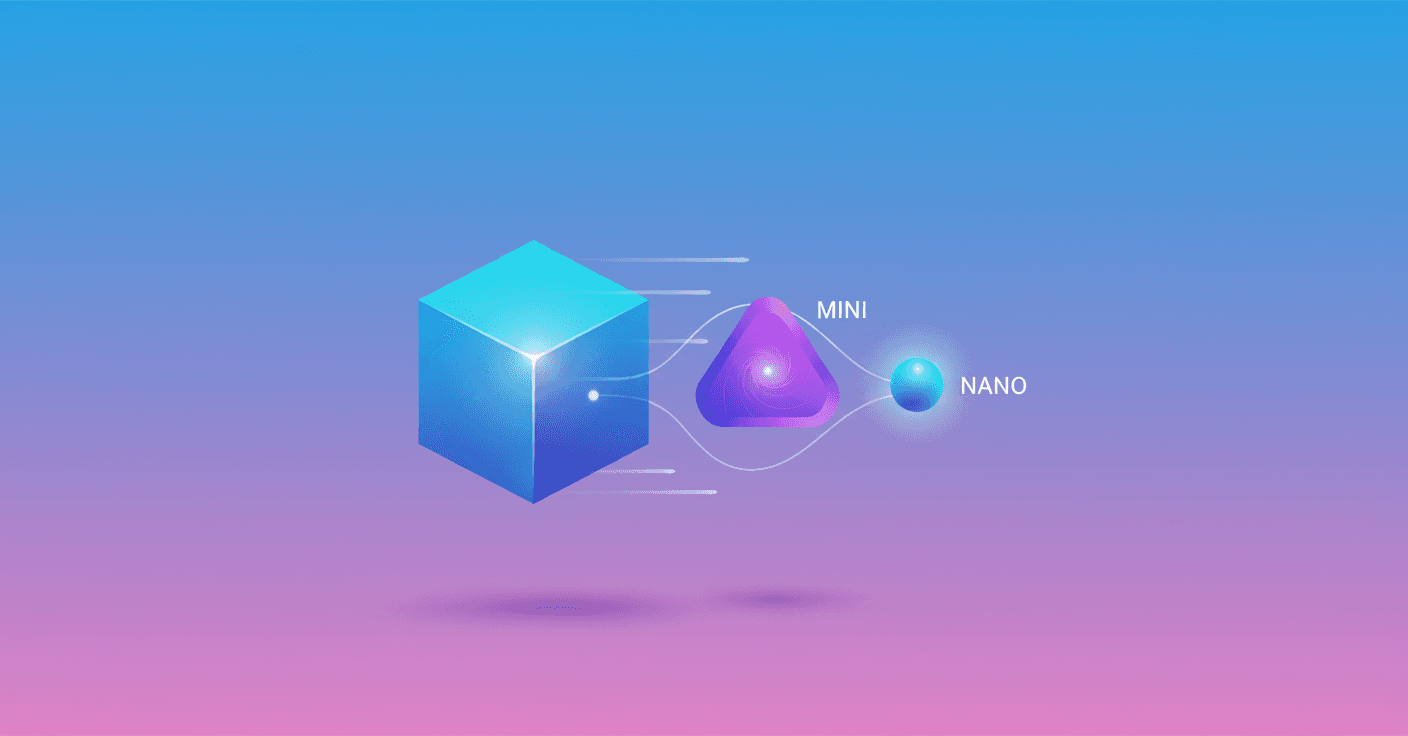
OpenAI has launched GPT-5.4 mini and GPT-5.4 nano, two smaller AI models designed to respond quickly and reduce costs. The mini model significantly outperforms GPT-5 mini in coding, reasoning, image understanding and tool use, while nano targets simple, high-volume tasks.
The idea is practical: not every system needs to use the largest model for every task. A coding assistant can let GPT-5.4 organize the work and assign GPT-5.4 mini to review files, find errors or process documents in parallel.
GPT-5.4 mini: less waiting and lower cost
GPT-5.4 mini runs at more than twice the speed of GPT-5 mini and comes close to GPT-5.4's performance in several tests. In SWE-Bench Pro, which measures a model's ability to solve real-world coding problems, it scored 54.4%, compared with 57.7% for the larger model and 45.7% for GPT-5 mini.
It also delivered better results on computer-use tasks. In OSWorld-Verified, a test that evaluates whether a model can interpret an interface and complete actions, it reached 72.1%, close to GPT-5.4's 75% and well above GPT-5 mini's 42%.
Its main results were:
- 60% on Terminal-Bench 2.0, compared with 38.2% for GPT-5 mini.
- 42.9% on Toolathlon, a tool-use test, compared with 26.9% for GPT-5 mini.
- 88% on GPQA Diamond, which measures advanced reasoning, compared with 81.6% for GPT-5 mini.
- 76.6% on MMMUPro, an evaluation of image understanding and other multimodal content, compared with 67.5% for GPT-5 mini.
These results do not mean that mini matches the larger model in every area. They do show that, for many tasks, it can deliver a good enough answer with less waiting and at a lower price.
GPT-5.4 nano prioritizes price
GPT-5.4 nano is the smallest and cheapest version in this family. OpenAI recommends it for classifying information, extracting data, ranking results and handling support tasks in coding.
It scored 52.4% on SWE-Bench Pro, above GPT-5 mini but below GPT-5.4 mini. On tool-use tasks, it reached 35.5% on Toolathlon and 92.5% on τ2-bench, a test focused on handling telecommunications requests.
Its role is not to handle the most complex problems. It is designed to process thousands or millions of simple requests without sending costs soaring. For example, it can read invoices and extract their amounts, classify customer messages or review small code changes before a more capable model makes the final decision.
Availability and pricing
GPT-5.4 mini is already available through the API, Codex and ChatGPT. In the API, it accepts text and images and can use web search, file search, tools, functions and computer-use capabilities. It has a 400,000-token context window, meaning it can work with large amounts of information in a single conversation or task.
It costs $0.75 per million input tokens and $4.50 per million output tokens. In Codex, it uses 30% of the GPT-5.4 quota, making it possible to use it for simpler tasks at approximately one-third of the cost.
In ChatGPT, GPT-5.4 mini is available to users on the Free and Go plans through the Thinking option in the "+" menu. For everyone else, it appears as an alternative when the GPT-5.4 Thinking limit is reached.
GPT-5.4 nano is available only through the API. It costs $0.20 per million input tokens and $1.25 per million output tokens.
For you, the most important change is not just that two new models exist. AI services can now start assigning each task to a model of a different size: larger models for planning and decision-making, and smaller ones for fast, large-scale execution. That combination will be key to helping assistants respond with less delay without turning every interaction into an expensive process.