OpenAI introduces AgentKit for building AI agents
OpenAI introduces AgentKit, a suite that brings together visual tools, connectors, chat interfaces, and evaluation systems for building AI agents. ChatKit and the new Evals features are now available, while Agent Builder and Connector Registry are entering beta.
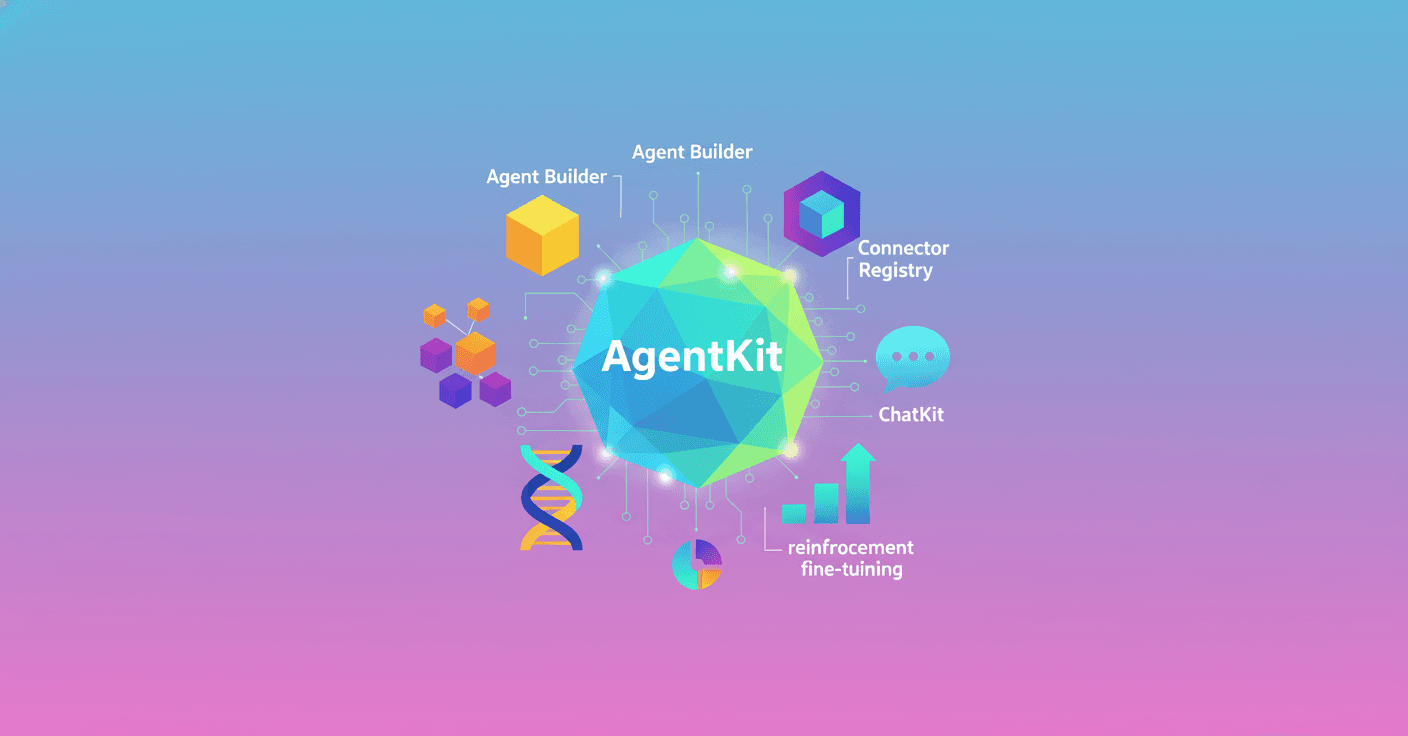
OpenAI is launching AgentKit, a set of tools that lets companies and developers build, test, and deploy AI agents without having to assemble every component separately.
Until now, building an agent meant combining orchestration systems, data connectors, manual testing, instruction tuning, and a custom interface. AgentKit brings much of that work together on one platform.
A visual canvas for building agents
The centerpiece is Agent Builder, a visual workspace where you can design workflows with drag-and-drop nodes. It lets you connect tools, coordinate multiple agents, add safety rules, run tests, and save different workflow versions.
The goal is to reduce the work normally required to write and maintain code for every change. According to OpenAI, Ramp went from a process that could take months to creating a purchasing agent in a few hours. The company also says it reduced its 70% iteration cycles and put the agent into production in two sprints, compared with two quarters.
LY Corporation, a Japanese technology and internet services company, says it created and launched its first multi-agent workflow in less than two hours using Agent Builder.
These figures are results reported by the companies themselves, not a guarantee for every project. The actual timeline will depend on the agent's complexity, the available data, and the approvals required.
More control over data and connections
AgentKit also includes Connector Registry, a dashboard that lets administrators manage how agents connect to data and tools across different workspaces and organizations.
The registry centralizes connectors for services such as:
- Dropbox
- Google Drive
- SharePoint
- Microsoft Teams
- Third-party tools based on MCP, a standard for connecting models with external services
This matters especially for large companies. Instead of having each team configure its connections separately, administrators can control which sources are available and who can use them through ChatGPT and the API.
OpenAI is now starting a limited beta of Connector Registry for some API, ChatGPT Enterprise, and ChatGPT Edu customers. Activating it requires access to the Global Admin console, which lets administrators manage domains, single sign-on, and multiple API organizations.
ChatKit brings the agent into your product
Building the chat interface an agent uses can require substantial work: displaying responses as they are generated, organizing conversations, managing threads, and designing an interface that fits an application or website.
ChatKit provides components for embedding a customizable chat experience inside a product. You can adapt it to your company's design and branding without building the entire interface from scratch.
Canva says it saved more than two weeks while creating a support agent for its developer community and integrated it in less than an hour. This type of agent can turn a documentation library into a guided conversation instead of forcing you to search through pages manually.
According to OpenAI, ChatKit is already being used in internal assistants, onboarding processes, customer support, and research tools.
Evals measures whether the agent really works
An agent that performs well in a demonstration can fail when it receives thousands of different requests. That is why OpenAI is expanding Evals, its system for testing model behavior and measuring performance.
The new features include:
- Datasets, for creating test case sets and expanding them with human reviews and automated graders.
- Trace grading, for analyzing an entire workflow and identifying the step where the agent went wrong.
- Automatic instruction optimization, which suggests improvements based on human annotations and test results.
- Support for third-party models, for comparing models from other providers within the evaluation platform.
OpenAI says one customer reduced development time for its multi-agent company analysis system by more than 50% and increased accuracy by 30%. Again, this is a result reported by that customer for its specific use case.
Specialized tuning with RFT
OpenAI is also expanding access to reinforcement fine-tuning, or RFT, a technique that adapts reasoning models using evaluations tailored to specific tasks.
RFT is generally available in o4-mini and in private beta for GPT-5. The beta adds two options:
- Custom tool calls, for training the model to choose the right tool and use it at the right time.
- Custom graders, for defining which criteria matter most in a specific use case.
For example, a company could evaluate not only whether an agent gets the answer right, but also whether it cites sources, respects access limits, or asks for confirmation before taking a sensitive action.
ChatKit and the new Evals features are now available to all developers. Agent Builder is entering beta, while Connector Registry is beginning a limited rollout. These tools are included with the standard pricing for API models.
OpenAI also previews a standalone API for workflows and new options for deploying agents directly in ChatGPT. The direction is clear: creating an agent is no longer just about choosing a model. You also need to organize its steps, control its connections, measure its errors, and decide when it can act on its own.