Olmo 3 opens up the entire process of creating an AI
Ai2 has released Olmo 3 with 7B and 32B models and published much more than its final weights: data, code, checkpoints and complete training paths. The proposal makes it possible to study, adapt and audit how an AI is built, with versions for reasoning, conversation and reinforcement learning experiments.
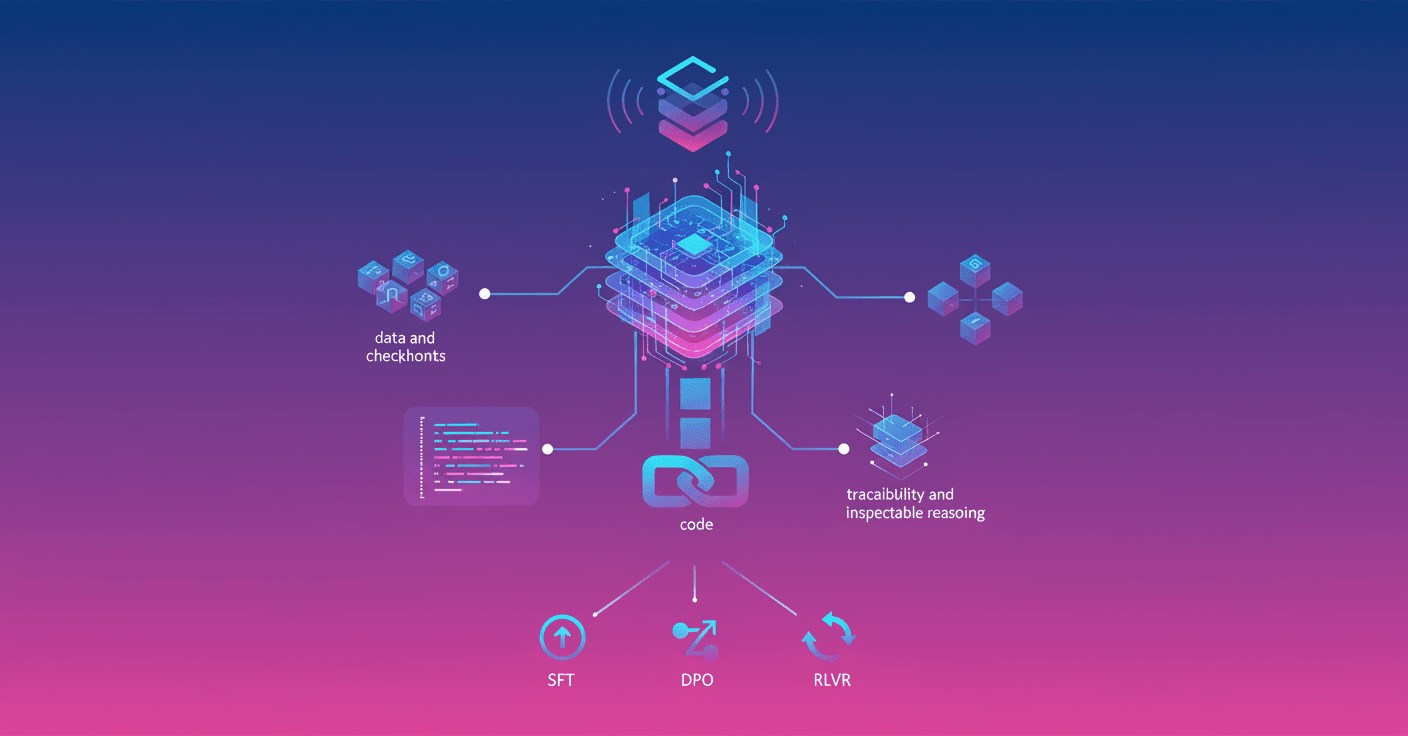
Ai2 has released Olmo 3, a family of AI models that publishes more than just its final weights: it also releases the data, code, intermediate training checkpoints and decisions used to build them.
The difference matters because a finished model is like a car delivered without blueprints or a repair manual. You can use it, but it is much harder to understand why it works, fix its failures or adapt it to a specific task.
A family of models for different uses
Olmo 3 includes models with 7 billion and 32 billion parameters, where a parameter is an internal variable the model adjusts during learning. The 7B models can run on more modest hardware, while the 32B models are intended for research and higher-capacity servers.
The family is divided into several versions:
- Olmo 3-Base: starting-point models for continuing training, specializing them or creating new versions.
- Olmo 3-Think: models focused on solving complex problems by showing intermediate reasoning steps. The 32B version is the family’s main model for mathematics, programming and long-running tasks.
- Olmo 3-Instruct: a version for conversation, following instructions and using digital tools.
- Olmo 3-RL Zero: an open training path for studying reinforcement learning, a technique that improves model behavior through rewards.
According to Ai2’s evaluations, Olmo 3-Base 32B is the best-performing fully open base model in its comparison, while Olmo 3-Think 32B stands out among fully open reasoning models of a similar size. These claims come from Ai2’s tests and do not mean that the model outperforms every available system.
The entire process is open
Ai2 defines this set of steps as the model flow: the entire journey from the initial data to the ready-to-use version. Olmo 3 publishes checkpoints from several stages, including the base model, intermediate training, context expansion and later specialization phases.
That means a team does not have to start from scratch. It can take an intermediate checkpoint, add medical or legal documents, change the training method or create a version focused on programming, for example.
It can also study the effect of each stage. If an improvement appears after adding more code or longer documents, researchers have more tools to check whether that change was actually the cause.
The flow itself becomes a reusable object, not just a record of how we built Olmo 3.
Open data and traceability
Training uses Dolma 3, a corpus of around 9.3 trillion tokens from web pages, scientific papers, code, mathematical problems and encyclopedic texts. For the main training run, Ai2 created a mixture of around 5.9 trillion tokens, with a greater emphasis on mathematics and programming.
The organization also publishes datasets for the intermediate and later stages, along with tools to clean, deduplicate and remove evaluation data from the training material. According to Ai2, it does not collect content from sites that explicitly prohibit its use and does not include paywalled pages.
Another component is OlmoTrace, a tool that attempts to link a model’s response to the data that may have influenced it. It does not automatically make the model transparent or prove a single cause for every response, but it offers a more concrete way to investigate its behavior.
What changes for you
If you only want to chat with an AI, the release will not immediately change your day-to-day life. Its importance lies in what people who need to control the system can do:
- Create specialized assistants without depending on a black box.
- Run models on their own infrastructure and adapt their responses.
- Investigate errors, biases and the effects of training data.
- Compare tuning methods and reproduce experiments.
- Build tools for programming, document analysis or function use.
The 32B model requires substantial computing capacity, especially during training. But it can be a useful middle ground: it offers more room than smaller models without requiring the infrastructure of the largest systems.
Olmo 3 does not prove that publishing more files alone solves the problems of transparency. It does mark a practical difference: instead of receiving only a finished model, the community gets pieces it can audit, modify and use to build alternatives. The next step will be to see whether independent teams can reproduce its results and whether that openness produces more reliable models beyond Ai2’s tests.