NVIDIA opens up Earth-2 models for weather forecasting
NVIDIA has released two open Earth-2 models and announced a third to cover everything from storm prediction to 15-day forecasts. The platform also includes tools for creating and training weather simulations with an organization's own data and infrastructure.
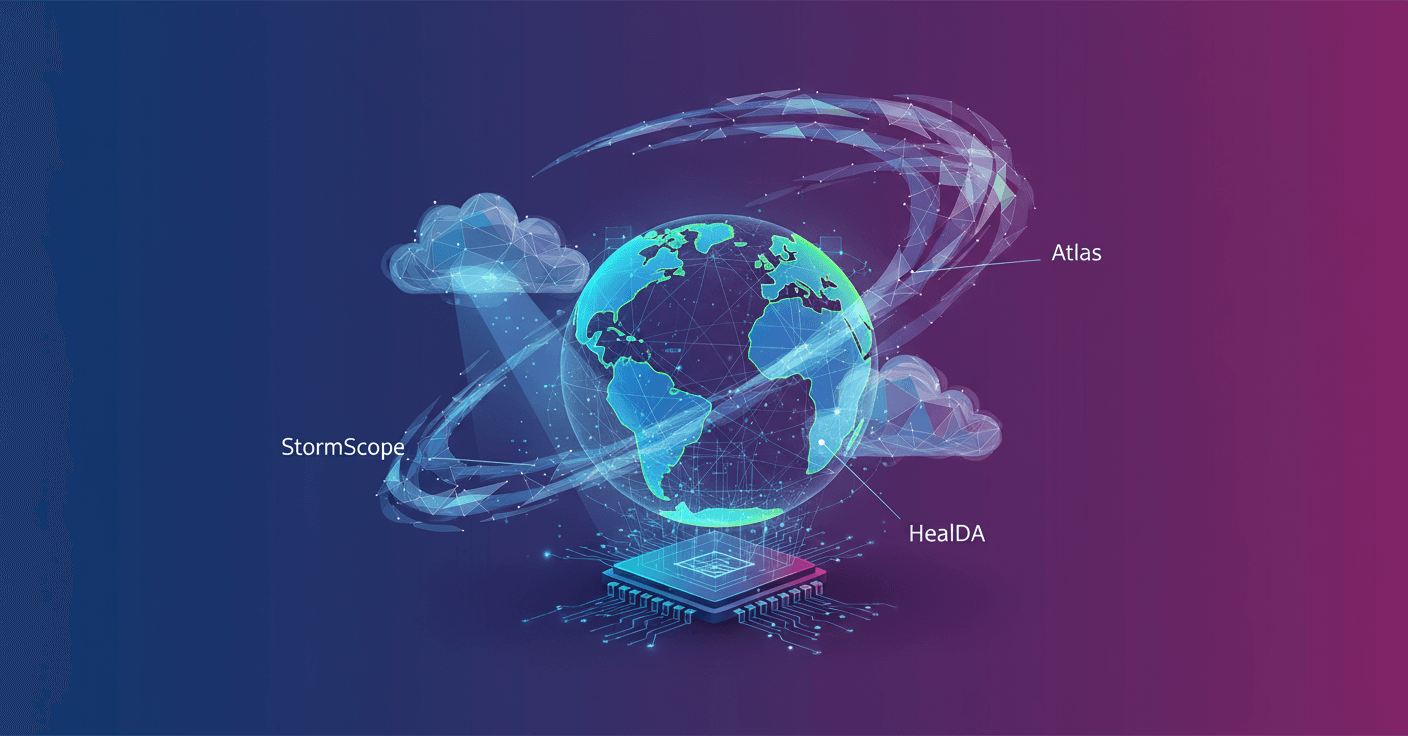
NVIDIA has released three open artificial intelligence models covering much of the weather forecasting process: from reconstructing the atmosphere's current state to predicting storms over the next few hours and producing forecasts for up to 15 days.
The models are part of NVIDIA Earth-2, a collection of models and tools for creating weather and climate simulations. Because they are open, developers can adapt them to their own data, infrastructure, and regions instead of relying entirely on an external service.
Three models for different time scales
The first is already available on Hugging Face: Earth-2 Nowcasting. It is designed to predict storms and other dangerous weather phenomena at kilometer-scale resolution over a horizon of zero to six hours.
Its architecture, called StormScope, uses generative artificial intelligence to directly simulate how storms evolve from satellite and radar data. NVIDIA says the model can generate country-scale predictions in minutes and that, for short-term precipitation forecasting, it outperforms traditional physics-based models.
The published version was trained on observations from GOES geostationary satellites over the continental United States. The same method could be adapted to other regions with similar satellite coverage, although that would require training new versions.
Earth-2 Medium Range, based on the Atlas architecture, is also available. Its goal is to forecast weather up to 15 days ahead while tracking more than 70 atmospheric variables, including:
- Temperature
- Pressure
- Wind
- Humidity
Atlas uses an architecture called a latent diffusion transformer, which predicts gradual changes in the atmosphere to better preserve its structures and reduce errors. In the benchmark tests cited by NVIDIA, it outperforms open models such as GenCast on the weather variables most commonly used in the industry.
The third model, Earth-2 Global Data Assimilation, will arrive on Hugging Face soon. Its function is to generate the initial conditions weather models need: a snapshot of the atmosphere's current state, with temperature, wind, humidity, and pressure data at thousands of points around the planet.
According to NVIDIA, this process can be completed in seconds using GPUs, compared with the hours supercomputers typically require. Combined with Earth-2 Medium Range, the company says it forms one of the best-performing open weather forecasting pipelines based entirely on AI.
What changes for people developing these systems
Weather forecasting is not just a matter of asking a model whether it will rain tomorrow. First, you need to gather observations, reconstruct the atmosphere's state, calculate how it will evolve, and in many cases increase the resolution to obtain useful information at a local scale.
Earth-2 aims to cover those stages with compatible models and open tools. NVIDIA also offers Earth2Studio, a Python ecosystem for creating inference pipelines, meaning workflows that connect input data to predictions. For training models, it includes the open-source PhysicsNeMo software.
In practice, this could be used to create forecasts tailored to a specific region, storm warning systems, or climate simulations that an organization can run with its own data and infrastructure. It does not mean that end users will automatically receive a more accurate weather app: the result will depend on the data, configuration, and local validation.
The new models join other open NVIDIA projects, including FourCastNet3, CorrDiff, cBottle, and DLESym. The important point is that the company is not presenting Earth-2 as a single model, but as a complete foundation for building weather forecasts under the developer's control.
The next thing to watch will be the arrival of Earth-2 Global Data Assimilation and the ability to adapt these models to other parts of the world. If that expansion works, AI-based weather forecasting could move beyond major computing centers and reach more institutions capable of running and adjusting their own systems.