NVIDIA Nemotron 3 Embed tops the RTEB leaderboard
NVIDIA introduces Nemotron 3 Embed, a family of open models for semantic search, RAG and agent memory. Its 8B version ranks first on RTEB with 78.5%, while the 1B variants prioritize lower cost, latency and memory use.
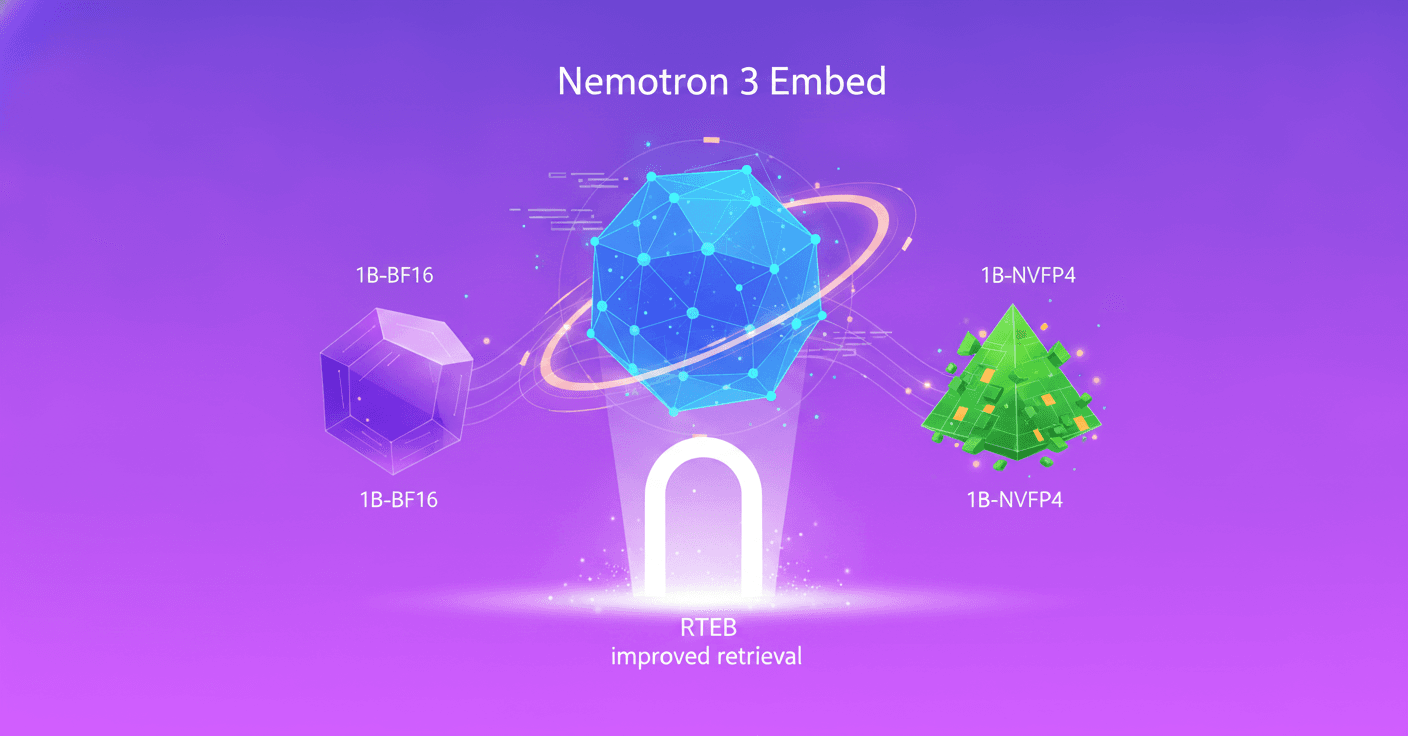
NVIDIA has launched Nemotron 3 Embed, a family of AI models that turns text, documents and code into numerical representations so systems can find relevant information. The flagship model, Nemotron-3-Embed-8B-BF16, ranks first on the RTEB leaderboard, according to tests published by NVIDIA.
These representations, known as embeddings, are a key part of semantic search and RAG systems. Instead of searching only for exact words, they can find documents related to the meaning of a query. For example, a question about “how to recover an account” can locate a guide titled “credential reset,” even if the two do not use the same words.
Three models for different cost levels
The family includes three open models with different goals:
Nemotron-3-Embed-8B-BF16: the highest-quality model, designed for searches where accuracy is the priority.Nemotron-3-Embed-1B-BF16: a smaller option for systems where latency and cost matter.Nemotron-3-Embed-1B-NVFP4: a variant optimized for NVIDIA Blackwell hardware and high query volumes.
The 8 billion-parameter model scored 78.5% on RTEB and 75.5% on MMTEB Retrieval. RTEB is a set of tests that compares how well different models retrieve relevant information across multiple tasks and languages.
The 1.14 billion-parameter version reached 72.4% on RTEB. NVIDIA says this reduces the error rate by 27% compared with its previous model of a similar size, llama-nemotron-embed-vl-1b-v2. It scored 71% on MMTEB Retrieval, with a 28% reduction in error compared with that predecessor.
Why it matters for AI agents
A more accurate search engine does not just improve the results a person sees. It can also reduce the work an AI agent has to do. If it finds the right evidence sooner, it needs fewer repeated searches, fewer reasoning steps and less text to process.
In NVIDIA’s tests, an agent based on Nemotron 3 Ultra used the new embeddings in ViDoRe V3, BRIGHT and BrowseComp-Plus tasks. The company says the 8B model achieved the highest average accuracy and the lowest estimated token cost per query across that evaluation set. That cost was calculated using the price of GPT-5.5, so it does not necessarily represent the expense of every real-world system.
The models also offer a 32,000-token context window, enough to work with long documents, code repositories and an agent’s conversation history. They include multilingual support and can be adapted to fields such as finance, healthcare, education and legal affairs.
Smaller size, more speed
The Nemotron-3-Embed-1B-NVFP4 variant reduces the size of its calculations through NVFP4, a 4-bit format optimized for NVIDIA Blackwell GPUs. NVIDIA says it can achieve up to twice the performance of the BF16 version in certain high-demand scenarios while retaining more than 99% of its retrieval accuracy and using less memory.
The company also offers an NVIDIA NIM microservice for deploying the model in production, along with compatibility with Hugging Face and vLLM. The weights, data and training recipes are available so companies can inspect, fine-tune and run the models on their own infrastructure.
Fine-tuning with proprietary data can make a significant difference. In an evaluation using NVIDIA documentation, adapting the 1B model raised the NDCG@10 score from 56.7% to 63.3% and Recall@5 from 56.1% to 62.8%.
For you, the most relevant change is not the ranking by itself. It is that the search powering assistants, internal search engines and agent memory can become more accurate without forcing every company to use a large, expensive model. The next point to watch will be how these results perform on real enterprise data, where document quality, language and domain fit often matter as much as the model.