NVIDIA launches Cosmos 3 Edge for robots at the edge
NVIDIA introduces Cosmos 3 Edge, an open 4-billion-parameter model that helps robots and vision systems understand their surroundings and act directly from edge devices. It can generate 32 actions per inference and reach 15 Hz on NVIDIA Jetson Thor, while also including tools for adapting the model to specific robotic tasks.
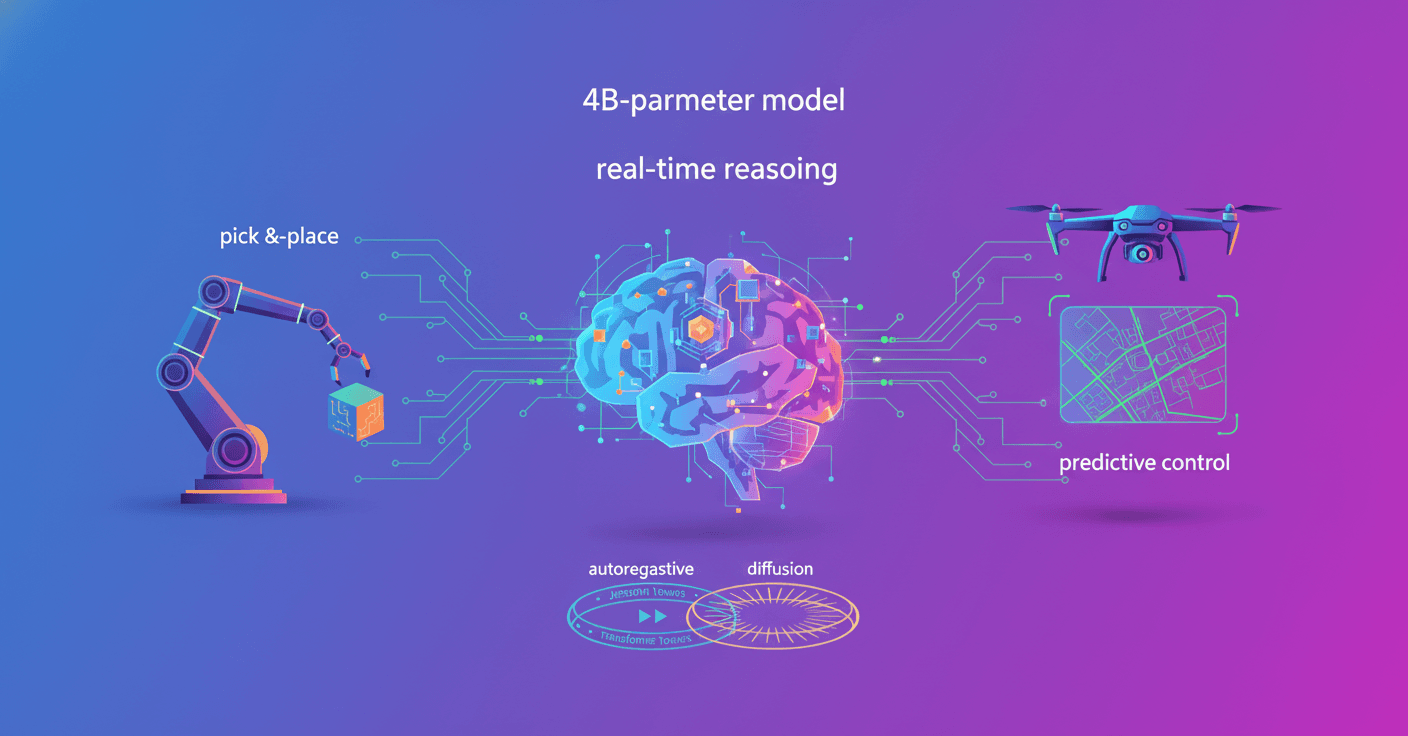
NVIDIA has launched Cosmos 3 Edge, an open 4-billion-parameter model designed to help robots and vision systems understand their surroundings and act directly from edge devices, without relying on a data center all the time.
The model is aimed at factories, warehouses, hospitals and other places where machines need to respond in real time. It can run on systems including NVIDIA Jetson, RTX PRO, DGX and GeForce RTX cards, as well as the new Jetson T2000 and T3000 modules.
A model that does more than see: it decides
Cosmos 3 Edge works as a vision-language model, connecting images, text, movement and actions. But its goal goes beyond identifying objects.
For example, to pick up a banana and place it on a plate, a robot needs to know where the object is, how to move the gripper, what will happen when it makes contact and what to do if the movement does not go as expected. The model tries to connect all those pieces.
NVIDIA describes it as a world model. This type of system learns how environments change over time: which objects move, how they relate to one another and what effects an action may have.
In practice, Cosmos 3 Edge receives the current state of a scene and can generate an action along with a prediction of its visual consequence. The robot does not just decide what to do. It also estimates what should happen next.
Real-time control from the device
The model works with 640 × 360-pixel observations, a resolution designed for robot control. On NVIDIA Jetson Thor, it can generate 32 actions per inference and reach real-time control at 15 Hz, or 15 decision cycles per second.
This matters because sending every image to the cloud adds latency and depends on a stable connection. With processing on the device, a camera or robot can react faster and keep working even when the connection is limited.
According to NVIDIA, among models of a similar size, Cosmos 3 Edge ranks first on VANTAGE-Bench for visual analysis and achieves reference results in robotic policy learning. These comparisons depend on the specific tests and tasks, so they do not mean the model is the best choice in every scenario.
Two parts for understanding and prediction
Cosmos 3 combines two main components:
- An autoregressive tower that processes images and text to understand and reason about the scene.
- A diffusion tower that processes images, audio and actions to predict outcomes, generate content and simulate changes.
Both share multimodal attention layers. Put simply, they can connect what the system sees with what it reads, hears or does.
The model also converts different types of movement into a common representation. A vehicle can describe its movement, a camera its motion and a robotic arm the position of its end effector. This representation includes translation, rotation and manipulation state, such as opening or closing a gripper.
This makes it possible to link visual changes with physical movement. A sequence generated by the model would not be just an animation. It can represent what would happen if the robot carried out a specific action.
Tools for adapting the model
NVIDIA is also releasing Cosmos 3 Edge Policy (DROID), a robotic policy trained on the DROID dataset for pick-and-place tasks. The package includes scripts for continuing the training process.
Developers can fine-tune the model for their own robots and environments using a small H100 cluster or an NVIDIA DGX Station before deploying it on edge hardware. NVIDIA is also publishing reference models, training recipes and scripts for adapting the system to specific tasks.
The company has also included a Cosmos 3 Super 4-Step checkpoint, a distilled version of a 64-billion-parameter model. For image and video generation, it reduces the diffusion process from between 35 and 50 steps to just four and delivers up to 25 times more speed, according to NVIDIA, while maintaining the quality and fidelity of the result.
For you, the most important change is that AI capable of interpreting a camera feed and controlling a machine can run closer to where the action takes place. That reduces reliance on the cloud, although its real-world usefulness will still depend on the hardware, training data and adaptation to each robot.
NVIDIA presents Cosmos 3 Edge as an open foundation for building physical AI systems, not as a robot ready for any task. The next thing to watch is how it performs after being fine-tuned with real-world data and whether its tools can move beyond controlled demonstrations into factories, warehouses and other unpredictable environments.