NVIDIA introduces GR00T N1.7 for humanoid robots
NVIDIA has launched GR00T N1.7, an open model with a commercial license for humanoid robots that combines vision, language, and motor control. It was trained on 20,854 hours of human video and aims to improve complex manipulation tasks, from packing products to assembling small parts.
NVIDIA has introduced GR00T N1.7, an open model with a commercial license that enables humanoid robots to interpret images and instructions to perform physical tasks. It is now available on Hugging Face and GitHub, with a focus on industrial environments.
The model is designed for tasks such as moving materials, packing products, inspecting parts, and handling delicate objects. It can also control hands with 22 degrees of freedom, an important capability for tasks that require precise finger movements, such as assembling small parts.
Two systems for thinking and moving
GR00T N1.7 has 3 billion parameters and belongs to the VLA category, models that connect vision, language, and action. In practice, it receives images from a camera, a written instruction, and data about the robot's state, such as the position of its joints.
Its architecture separates two functions:
- A high-level system interprets the instruction, breaks the task into steps, and decides what should happen.
- A low-level system converts that decision into continuous, precise movements for the robot's motors.
For example, when instructed to pick up a fragile part and place it in a box, the first system can organize the sequence. The second adjusts the position of the arms and the pressure of the fingers in real time to complete the action.
NVIDIA has validated the model on tasks that combine locomotion and manipulation, tabletop work, and bimanual operations. The tests were conducted on robots such as Unitree G1, Bimanual Manipulator YAM, and AGIBot Genie 1.
More human data to improve dexterity
GR00T N1.7's main new feature is training with 20,854 hours of first-person human video, covering more than 20 categories of tasks in sectors such as manufacturing, retail, healthcare, and the home.
These videos can include footage from cameras mounted on the head or wrists, along with data about hand movements. The idea is to take advantage of the fact that people and robots share a similar perspective when manipulating objects: two hands, a first-person viewpoint, and an environment filled with things to grasp or move.
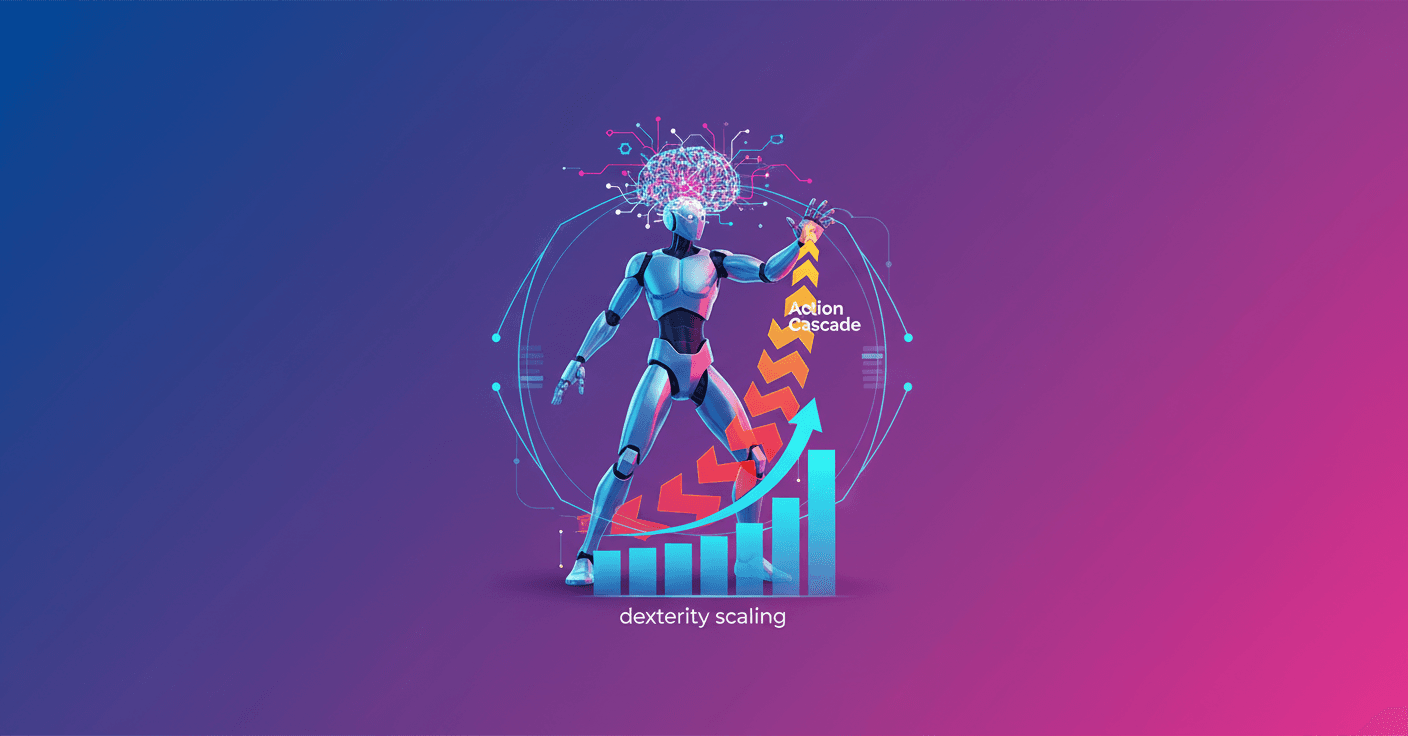
According to NVIDIA's research, more human data leads to predictable improvements in robotic dexterity. When the amount of video increases from 1,000 to 20,000 hours, the average task completion rate more than doubles. The company describes this result as a scaling law for robot dexterity, although its usefulness will depend on how well it transfers to different robots and environments.
What changes for robot developers
GR00T N1.7 can be fine-tuned with proprietary data using the LeRobot dataset format. This makes it possible to adapt the model to a specific platform instead of training everything from scratch. It is also compatible with robots and configurations that are already registered, including Unitree G1, Panda, and WidowX.
For those already using GR00T N1.6, the update works as a direct model replacement. Existing configurations and workflows remain in place, while N1.7 adds the Cosmos-Reason2-2B vision-language model and pretraining with EgoScale.
The model is compatible with NVIDIA Ampere, Hopper, Lovelace, Blackwell, and Jetson platforms. The commercial license allows it to be used in production deployments, but putting it into operation still requires a compatible robot, suitable data, and safety testing in each environment.
The important step is not just for a robot to follow instructions, but to learn manipulation patterns from large amounts of human video. What to watch now is whether that improvement holds outside test scenarios and genuinely reduces the number of robotic demonstrations needed to automate a range of physical tasks.