MolmoAct 2 brings open AI to real robots
Ai2 has introduced MolmoAct 2, an open model for robots that interprets 3D scenes and performs tasks with one or two arms. The organization is also publishing more than 720 hours of data and reports an average 87.1% success rate in real-world tests, although the system still has limitations outside controlled environments.
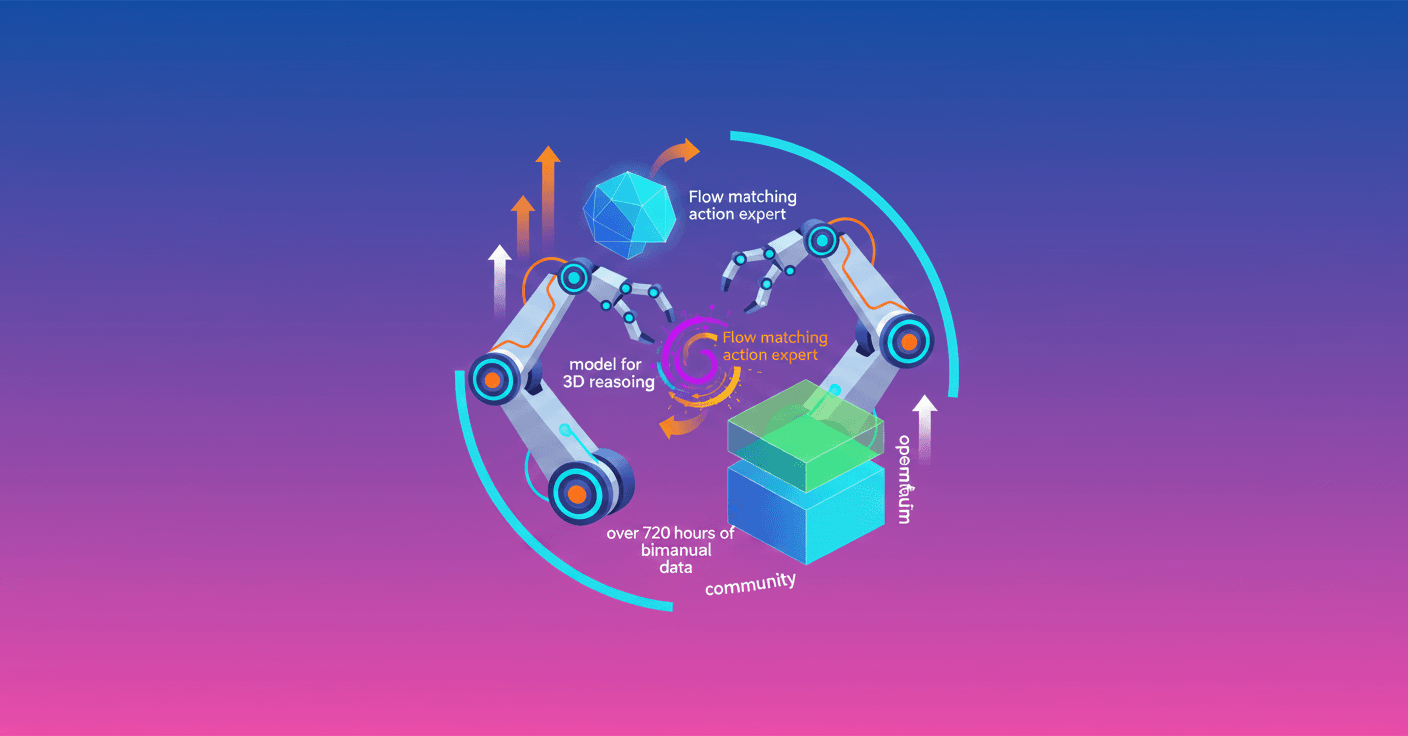
The Allen Institute for AI (Ai2) has introduced MolmoAct 2, an open model that allows robots to interpret their surroundings in 3D and perform physical tasks with less task-specific training. The organization is also publishing a dataset with more than 720 hours of demonstrations from two-arm robots.
The proposal targets a problem that still limits robotics: a robot may complete a task in one demonstration, but often fails when an object's position, the instructions or the scene conditions change. MolmoAct 2 is designed to help the machine understand intent and adapt more effectively.
A model that reasons before it moves
MolmoAct 2 combines a specialized vision-language model, Molmo 2-ER, with a component that generates the robot's actions. Before acting, the system analyzes objects, positions and spatial relationships, such as which item it needs to pick up or where it needs to place it.
Its reasoning foundation was trained on around 3 million examples covering object detection, visual pointing, spatial reasoning, and image and video understanding. It achieved an average score of 63.8 out of 100 across 13 robot reasoning tests, according to Ai2 evaluations.
The system also includes an open version of an action tokenizer. Put simply, this is the component that converts the robot's continuous movements into instructions the model can produce and process quickly.
That speed is one of its clearest improvements. In Ai2's tests, an action took about 180 milliseconds with the base model and 790 milliseconds when it used adaptive reasoning. Its predecessor, MolmoAct, needed around 6,700 milliseconds in the same test environment. Less waiting means smoother movements and a response closer to that of a real-time operating system.
Two arms and tasks closer to the real world
The new dataset, MolmoAct 2-Bimanual YAM, brings together more than 720 hours of demonstrations with two coordinated robotic arms. It includes tasks such as:
- Folding a towel.
- Scanning grocery items.
- Charging a phone.
- Picking up and organizing objects from a table.
Unlike the first MolmoAct, which needed task-specific adjustments to work with two arms, Ai2 says this capability is now part of the base model. The dataset also includes examples from other robots, cameras and control methods so the system does not depend on a single configuration.
What results does it achieve
In real-world tests with a Franka arm and no task-specific training, MolmoAct 2 achieved these results over 15 attempts per task, according to Ai2:
- 100% when moving an apple to a plate.
- 86.7% when placing a pipette in a tray.
- 93.3% when putting a red cube in the center of a roll of tape.
- 93.3% when putting a knife in a box.
- 62% when moving several objects into a bowl.
The average was 87.1%, compared with 48.4% for MolmoBot and 45.2% for π0.5 in the same evaluation. In another test conducted by Cortex AI, MolmoAct 2 achieved the highest average score among five systems, with 0.51 compared with 0.36 for OpenVLA-OFT.
In Ai2's lab, the model also achieved a 97.2% success rate on LIBERO after additional training. The MolmoAct 2-Think version, which uses explicit depth information for some tasks, reached 98.1%.
What this changes for you
The release includes the model weights, the data and an updated architecture so other teams can study and adapt them. That lowers one of the usual barriers in robotics: many systems work, but their data and methods remain closed.
Ai2 is testing MolmoAct 2 with robotic arms in a Stanford lab that works on gene editing. There, the system moves samples between stations and operates benchtop equipment, repetitive tasks where one mistake can affect an entire experiment.
It is still not an autonomous robot for every home or factory. It can fail if its own gripper blocks the camera, if it needs highly precise movements or if the control system does not respond in time. Visual instructions traced by a person can also produce depth errors.
The important point is the approach: MolmoAct 2 is not presented only as a robot that posts strong numbers in a test, but as an open foundation for other researchers to measure, correct and expand its capabilities. The next challenge will be to see how much of that performance holds up when scenes change, tasks last longer and errors stop occurring under controlled conditions.