Mistral launches Voxtral to transcribe voice in real time
Mistral has launched Voxtral Transcribe 2, a family of AI models that converts speech into text with speaker identification, timestamps and support for 13 languages. Voxtral Realtime offers configurable latency below 200 milliseconds and releases its weights under the Apache 2.0 license.
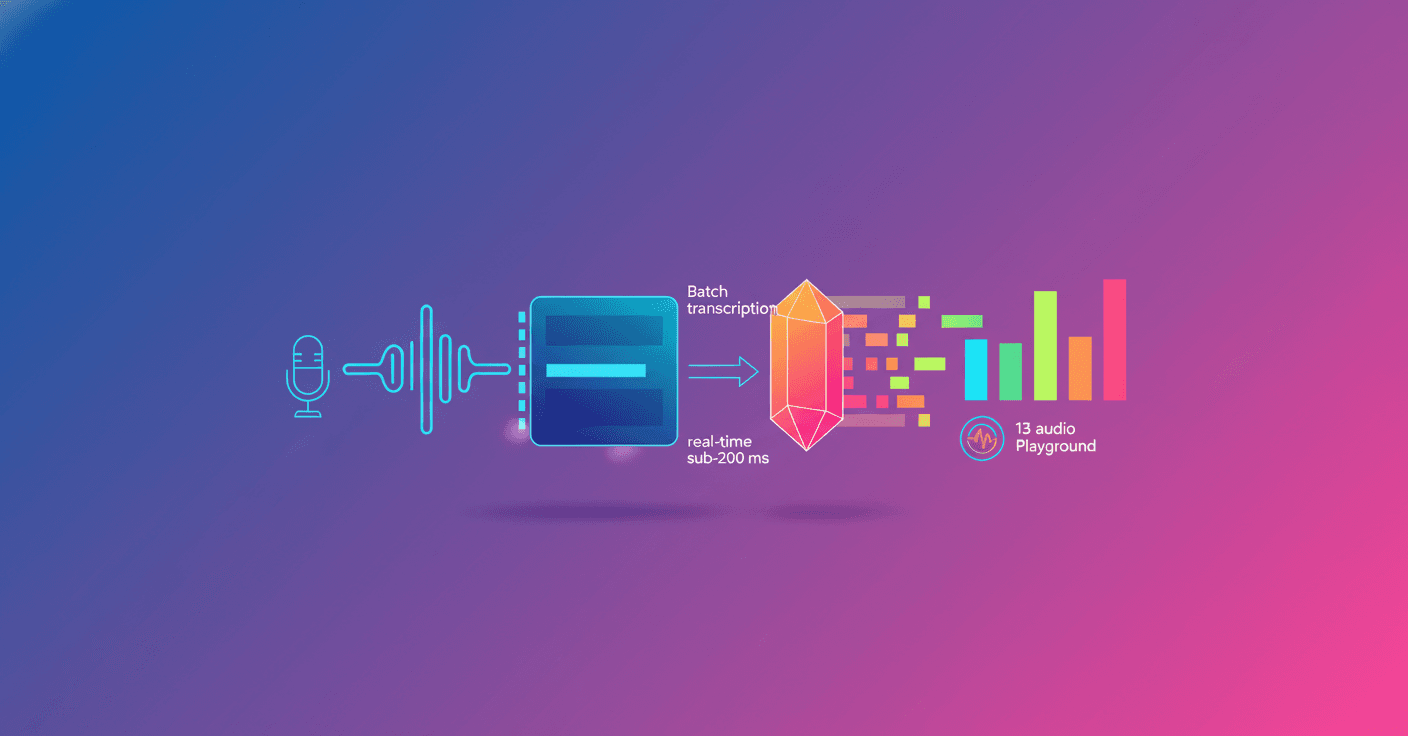
Mistral has launched Voxtral Transcribe 2, a family of AI models that converts speech into text with low latency, identifies speakers and adds precise timestamps. It includes one version for processing recordings and another designed for applications that need to respond while someone is still speaking.
The release includes two models:
Voxtral Mini Transcribe V2, for batch transcription of meetings, interviews, calls and audio files.Voxtral Realtime, for live captions, voice assistants and conversations with AI.
Real-time transcription with less than 200 milliseconds of latency
Voxtral Realtime processes audio as it arrives instead of waiting to collect several seconds before transcribing it. Its delay can be configured to below 200 milliseconds, depending on the balance between speed and accuracy each application needs.
According to Mistral, with a delay of 2.4 seconds, the model matches the quality of Voxtral Mini Transcribe V2, its batch-processing model. At 480 milliseconds, it remains within 1% to 2% of the batch model's word error rate.
That makes it possible to build voice agents that respond more naturally. For example, an assistant could receive your sentence, send it to a language model and start responding without waiting for a complete recording to finish.
Voxtral Realtime has 4 billion parameters, a scale that Mistral says allows it to run efficiently on local devices. Its weights are released under the Apache 2.0 license, so companies can deploy it on their own servers or devices. That matters for sensitive data and applications that do not want to send audio to the cloud.
More control over transcriptions
Voxtral Mini Transcribe V2 includes features designed for companies and teams working with large volumes of audio:
- Speaker identification: labels who said each sentence and when, a function known as diarization.
- Word-level timestamps: indicates the start and end of each word to create captions or find specific sections.
- Context adaptation: lets you enter up to 100 names, terms or phrases to reduce errors with technical vocabulary.
- Support for audio files of up to three hours in a single request.
- Greater noise resistance in places such as factories, call centers and field recordings.
Both models work in 13 languages: English, Chinese, Hindi, Spanish, Arabic, French, Portuguese, Russian, German, Japanese, Korean, Italian and Dutch. For audio with several people speaking at the same time, Mistral warns that the model normally transcribes only one of the overlapping speakers.
Pricing and availability
Mistral says Voxtral Mini Transcribe V2 achieves approximately a 4% word error rate on the multilingual FLEURS benchmark and costs $0.003 per minute. The company says it outperforms services such as GPT-4o mini Transcribe, Gemini 2.5 Flash, Assembly Universal and Deepgram Nova for accuracy in its comparisons.
Voxtral Realtime costs $0.006 per minute through the API and is also available with its open weights on Hugging Face. The Mini version can be tested through Mistral's API, in Le Chat and in Mistral Studio's new audio player.
The player lets you upload up to 10 audio files, turn on speaker identification, choose the level of detail for timestamps and add specific terms. It supports files of up to 1 GB in formats such as .mp3, .wav, .m4a, .flac and .ogg.
For you, the difference depends on where you use voice. In a meeting, it can automatically separate speakers. In a call center, it can transcribe and analyze a conversation as it happens. And during a broadcast, it can generate multilingual captions with less delay.
The next question is how these models perform outside Mistral's tests, especially with accents, noise, overlapping conversations and highly specialized vocabulary. The important point is that transcription is no longer just a task performed after audio is recorded. It is starting to become an active part of the applications that talk to you.