Meta launches Muse Glimmer, a local multimodal AI
Meta has introduced Muse Glimmer, an open model with 30 billion parameters that understands text, images and videos, uses tools and can program. It supports Transformers, llama.cpp and vLLM, although running it locally requires powerful hardware. Its results are competitive in coding and reasoning, but it does not lead every test against Gemma 4 and Qwen3.6.
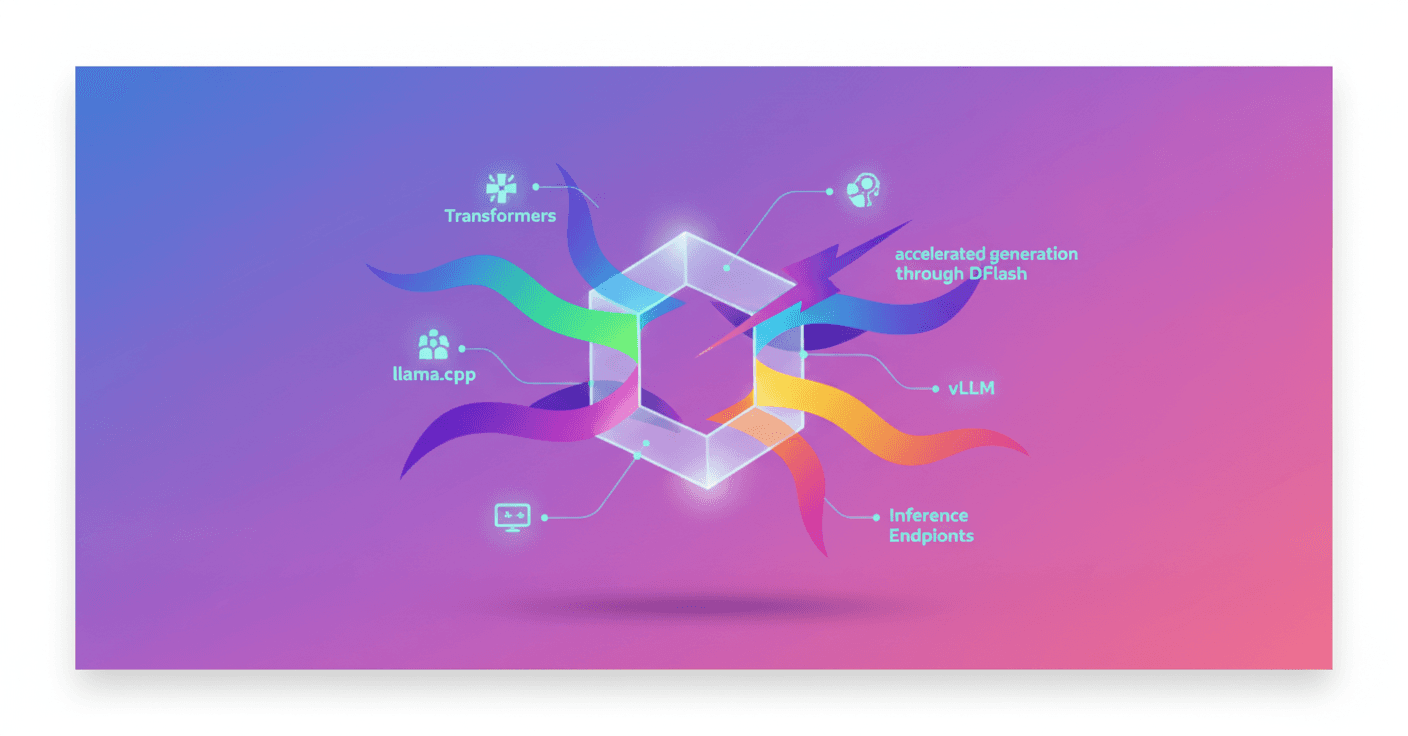
Meta has introduced Muse Glimmer, an open AI model that can work with text, images and videos, use external tools and run programming tasks. The company presents it as an assistant you can deploy on your own machine or connect to cloud services.
The model supports Transformers, llama.cpp, vLLM and Hugging Face Inference Endpoints from day one. That makes it easier to test in different environments, although its requirements are closer to a professional server than a home computer.
What Muse Glimmer can do
Muse Glimmer is not limited to answering questions. It is designed to carry out multi-step tasks, a capability known as agentic AI. For example, it can query a weather tool after identifying a city in an image, analyze a video recording or write and run code.
It also understands visual content directly:
- It can describe images and detect objects while indicating their coordinates.
- It can analyze videos without audio and answer questions about what happens in them.
- It can combine an image with text instructions to decide which tool to use.
- It can generate structured responses that are useful for software applications and agents.
In a Hugging Face example, the model recognizes a city in a photograph and prepares a call to a weather tool. In another, it locates a bridge and returns a box showing its position within the image.
A model with 30 billion parameters
Muse Glimmer has 30 billion parameters, an approximate measure of the model's internal capacity. It is split between a text decoder with 28 billion parameters and a visual encoder with 2 billion.
That visual component processes both images and videos. For videos, the system normally works with 2 frames per second and can analyze clips of up to 96 uniformly sampled frames. This allows it to study an entire scene without processing every frame in the original file.
The architecture combines local attention, which focuses on small windows of 2,048 tokens, with full-attention layers that can connect information across the entire context. In practice, the goal is to reduce memory usage without losing the ability to connect distant details within a document or conversation.
Results: strong at coding, uneven elsewhere
Meta compares Muse Glimmer-30B High Reasoning with Gemma 4-31B and Qwen3.6-27B across a series of tests. The results do not show an overall winner, but they do position the model as competitive in several areas.
Muse Glimmer achieves better results than the other two models in tests such as:
SWE-Bench Pro: 51.2, compared with 36.9 for Gemma 4 and 50.2 for Qwen3.6.SciCode: 43.6, ahead of 43.4 and 39.8.AIME 2026: 94.7, compared with 89.2 and 94.1.IFBench: 77.0, compared with 76.0 and 70.8.AA-LCR: 80.0, compared with 68.3 and 73.3.
But Qwen3.6 outperforms Muse Glimmer in several agent tests, such as OSWorld-Verified, where it reaches 75.6 compared with 65.9, and SWE-Bench Verified, with 77.2 compared with 76.0. It also achieves better results in several multimodal tests, including MMMU Pro and OmniDocBench.
In safety, Muse Glimmer records an attack success rate of 28.4% on Siren AgentDojo, compared with 25.6% for Gemma 4 and 40.3% for Qwen3.6. In this test, a lower figure is better. The results serve as a reference, not a guarantee that the model is safe in every application.
It can run locally, with caveats
The model is available for use with open tools and includes quantized versions, meaning reduced-size files that use less memory. Even so, the practical requirement listed for inference in BF16 format is one 80 GB H100 GPU.
Fine-tuning the model with LoRA, a technique that modifies only a small portion of its parameters, also requires at least one 80 GB H100. Full training requires several professional GPUs. So “local” does not necessarily mean “on your laptop”: it means you can control the deployment on your own infrastructure if you have the right hardware.
Muse Glimmer also includes DFlash, an auxiliary model that proposes several tokens in advance to speed up generation. The technique can be especially useful when writing code and is integrated into Transformers and llama.cpp.
What this changes for you
If you develop software, Muse Glimmer offers an open foundation for building agents that can see screens, read documents, analyze videos, call tools and write code. If you only want to chat with an AI, its advantages are less immediate: you will need powerful hardware or have to pay for a cloud endpoint.
The most relevant part of this launch is not that it wins every test. It is that Meta is delivering a multimodal, agent-oriented model with broad support from day one, along with tools to run it, quantize it and connect it to applications compatible with the OpenAI API.
The next thing to watch will be its performance outside benchmarks: how long it takes to respond, how much it costs to keep running and how it behaves when it has to chain real actions without supervision. That will determine whether Muse Glimmer is a practical option for local assistants or simply another technical component for experimentation.