Liquid AI launches LFM2.5, a local 2.6B agent
Liquid AI has launched `LFM2.5-2.6B`, a 2.6 billion parameter model designed to run AI agents locally. The company says it competes with much larger models in instruction following and tool use, with speeds of 220 tokens per second on CPU. The model runs with less than 2.5 GB of memory and already supports the main inference environments, although larger models still perform better at programming.
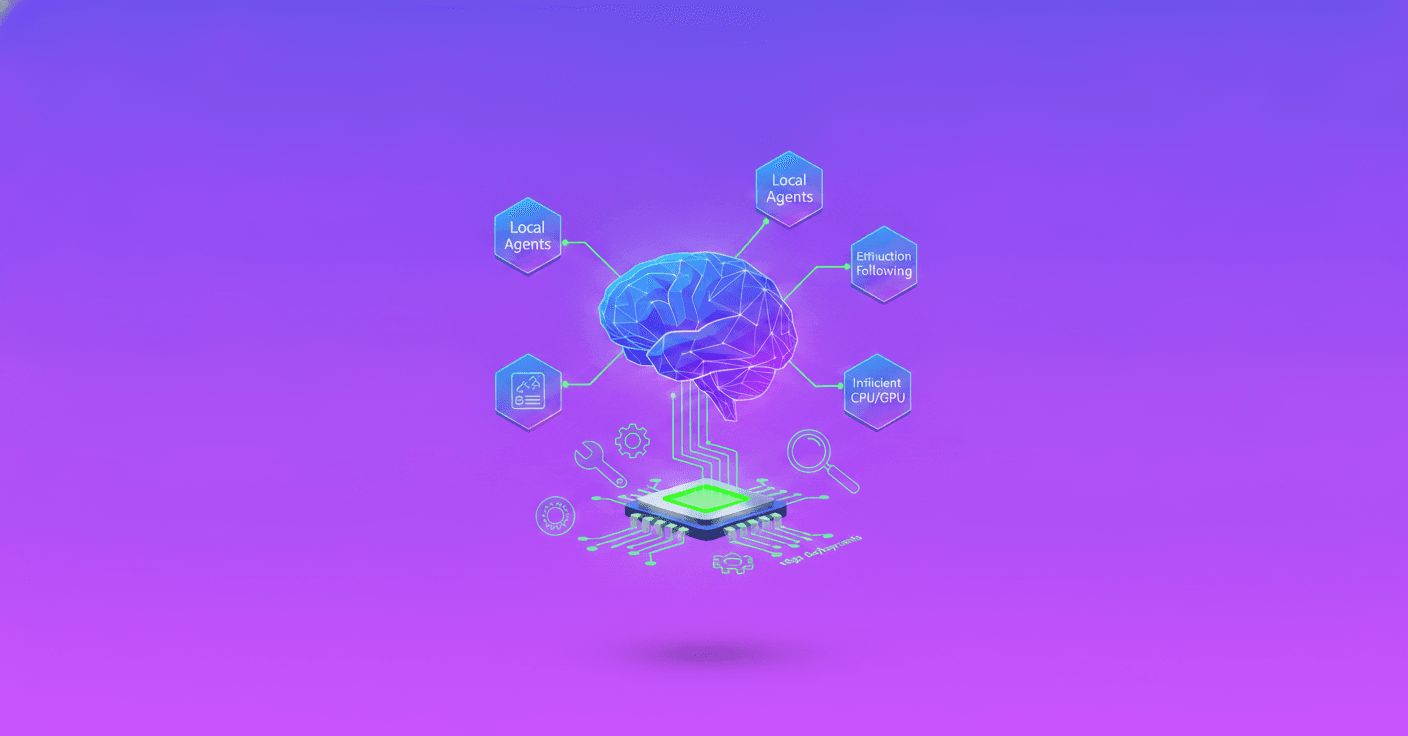
Liquid AI has made LFM2.5-2.6B available, an AI model designed to run agents directly on your computer, phone, or server. It has 2.6 billion parameters and needs less than 2.5 GB of memory to run.
The idea is simple: handle tasks that go beyond answering questions. The model can follow instructions, use tools, search for information, and complete multi-step processes without always relying on a cloud API.
A small model focused on taking action
Liquid AI says LFM2.5-2.6B competes with models up to four times its size in instruction following, tool use, and agentic tasks. In this context, an agent is a system that decides which steps to take and which tools to use to reach a goal.
For example, instead of simply explaining how to research a topic, the model can work inside a research agent: consulting sources, organizing data, and preparing a summary. It can also integrate with environments such as OpenClaw, Hermes Agent, and Pi.
The company trained the model on around 34 trillion tokens, the units of text models use to learn. It then expanded the context window to 128,000 tokens, allowing it to handle long conversations, documents, or task histories.
Training inside real agents
The model was not trained only on questions and answers. Liquid AI used a four-stage process:
- Two rounds of supervised fine-tuning, with a strong focus on tool use, web searches, and agent trajectories.
- Specialized teachers for areas such as mathematics, coding, and tool use.
- Distillation of those teachers into a single model to combine their capabilities.
- Reinforcement learning inside real agents and multi-turn tasks.
Reinforcement learning allows the model to receive a signal about whether its actions were useful and adjust its behavior. In this case, the actions run in an isolated environment, or sandbox, which separates agent training from the tools and tasks it interacts with.
This approach aims to make the model compatible with different agent systems, initial instructions, and tool sequences, rather than performing well only in a controlled test.
The results: strong at instructions and tools
According to tests published by Liquid AI, LFM2.5-2.6B was the smallest model in the comparison and was measured against models with between 4.7 and 9.7 billion parameters.
Its strongest results appear in these areas:
- Instruction following: it scored 59.17 on IFBench, 80.07 on Multi-IF, and 85.49 on IFStruct.
- Tool use: it reached 77.83 on ToolSandbox and 56.88 on BFCLv4.
- Agentic tasks: it achieved an average of 62.85 on Claw-Eval in English and 26.89 on BrowseComp+ with OpenClaw.
Liquid AI says the model leads all instruction-following tests in the comparison and all tool-use tests except BFCLv4, where Qwen3.5-9B scores slightly higher.
It does not win at everything. Larger models retain a clear advantage in programming: Qwen3.5-9B scored 69.86 on LiveCodeBenchv6, compared with 59.41 for Liquid AI's model. For writing complex code, using a larger model still makes sense.
Speed for local use
The main practical advantage is cost and speed. Liquid AI measured 220 tokens per second on an Apple M5 Max and 113 tokens per second on an AMD Ryzen AI Max+ 395 processor, using the CPU.
That makes it possible to run agents without a dedicated GPU and, according to the company, even use the model on a phone at 30 tokens per second. On an H100 GPU, the model reaches nearly 15,000 tokens per second with many simultaneous requests, equivalent to around 1.3 billion tokens per day on a single card.
The model supports tools such as llama.cpp, MLX, vLLM, SGLang, and ONNX from day one. You can also try it through a WebGPU demo in the browser, without installing a full environment.
For you, this means some tasks you currently send to an external service could run on your own device: classifying documents, querying a database, automating internal processes, or coordinating several tools. The trade-off is that the model is more specialized in following instructions and taking action than in solving the most demanding programming problems.
LFM2.5-2.6B and its base version are already available on Hugging Face. The important question now is how it performs outside Liquid AI's tests: on long tasks, with imperfect tools, and on real devices. If it maintains that speed and reliability, local agents could become much easier to deploy and cheaper to operate.