Holo3.1 brings AI agents to mobile and PC
H Company has launched Holo3.1, a family of AI agents capable of operating across browsers, computers and mobile devices, with support for local execution. The update notably improves Android results and adds quantized versions to reduce costs, resource use and reliance on the cloud.
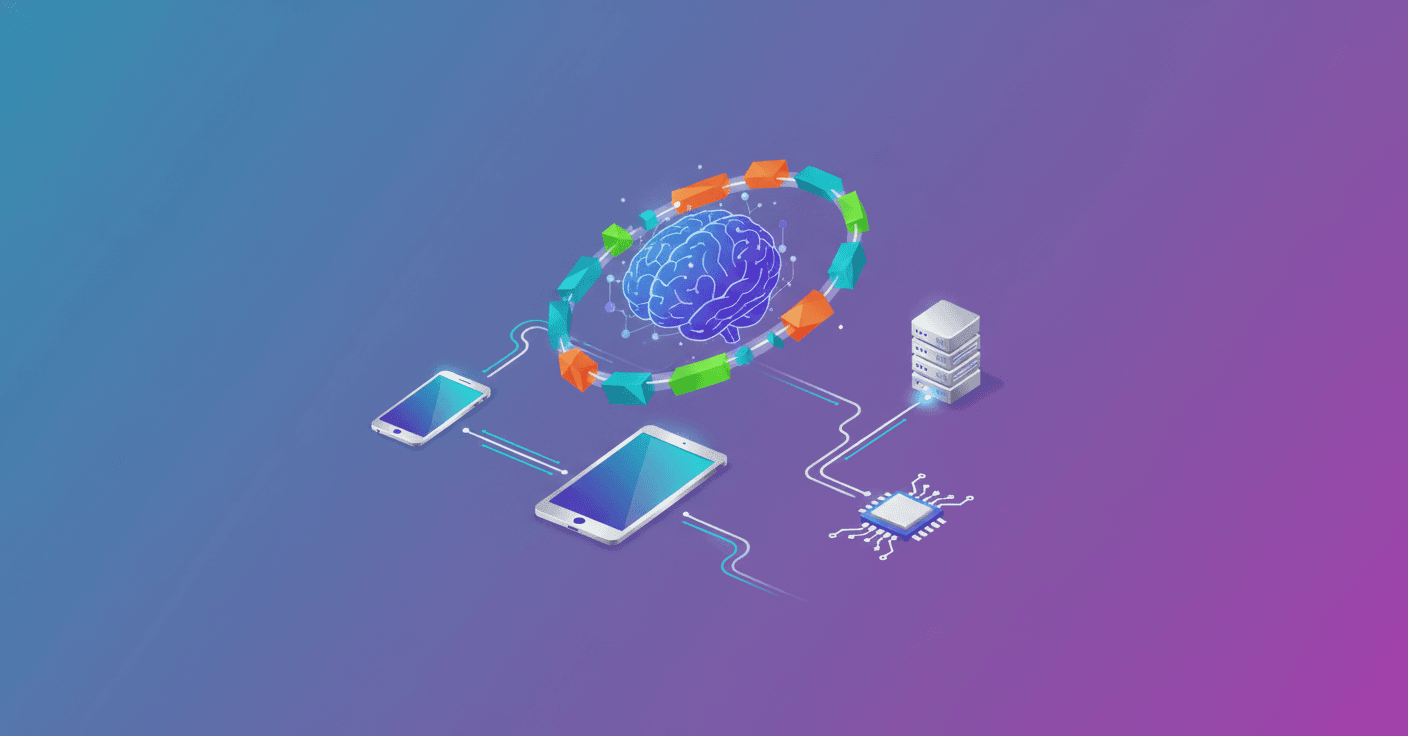
H Company has launched Holo3.1, a family of models that lets AI agents control browsers, computers and mobile devices, with options to run in the cloud or locally on the user's device.
The update targets a common problem: an agent may work well in a browser but fail when it switches to a desktop app, a mobile device or a different platform. Holo3.1 is designed to deliver more consistent performance across these environments.
Better performance on mobile
The clearest improvement appears in AndroidWorld, a benchmark that measures an agent's ability to complete tasks on an Android phone. According to H Company, the 35B-A3B model raises its success rate from 67% to 79.3% compared with Holo3.
The smaller models also improve:
4B: from 58% to 72%.9B: from 58% to 72%.
These figures do not mean the agent always gets things right or that every app is equally compatible. They show the results on a specific benchmark, but they also indicate that moving agents to mobile is a priority for this release.
Compatible with more agent tools
Holo3.1 adds native support for function calling protocols. This system lets a model request specific actions from a program, such as opening a page, clicking a button or querying a database, rather than limiting it to returning text.
The family already offered structured JSON outputs, an organized format that makes integration with software easier. Developers can now connect Holo3.1 to more agent platforms and frameworks without having to adapt their entire infrastructure.
In H Company's tests across operating systems, e-commerce, enterprise software and collaboration tools, native execution and function calling delivered nearly equivalent results. Within the testing environment for its Holotab product, Holo3.1 improved by more than 25% over Holo3.
Small models for local execution
The family comes in four sizes:
0.8B, for very lightweight local agents.4B, for low-cost deployments.9B, as a balance between speed and capability.35B-A3B, focused on maximum performance.
The important addition is that H Company is also publishing quantized versions. Quantization reduces a model's size and resource consumption, making it easier to run on local systems. The available variants are FP8, Q4 GGUF and NVFP4.
For the 35B-A3B model, H Company says FP8 and NVFP4 maintain the same score on OSWorld and rank approximately two points below the full BF16 version. On a DGX Spark, NVFP4 delivers 1.41 times the token throughput of FP8 and 1.74 times that of BF16.
What this means for you
An agent like this could carry out tasks directly on your computer, such as browsing a store, filling out forms or working with an enterprise application. With quantized models, some of those operations can stay within your network instead of sending every screen or instruction to an external server.
H Company says that, on a DGX Spark, combining agent optimizations with NVFP4 cuts the average time per step from 6.8 to 3.3 seconds, roughly twice as fast as its reference FP8 configuration.
That does not automatically turn every laptop into an autonomous assistant. Performance will depend on the hardware, the model selected and the applications the agent has to control. But it does make it easier to test computer-use agents on more modest systems while keeping greater control over your data.
Holo3.1 points these systems in a specific direction: they should not remain limited to the browser or depend on a single platform. The next thing to watch is whether the smaller models can maintain that robustness on real computers and mobile devices, where interfaces change constantly and resources are far more limited.