GPT-5 speeds up scientific research with experts
OpenAI presents cases in which GPT-5 helped complete a mathematical proof, detect errors, connect research and propose a biology experiment. Scientists still have to review and validate every result because the model can also make mistakes or invent plausible explanations.
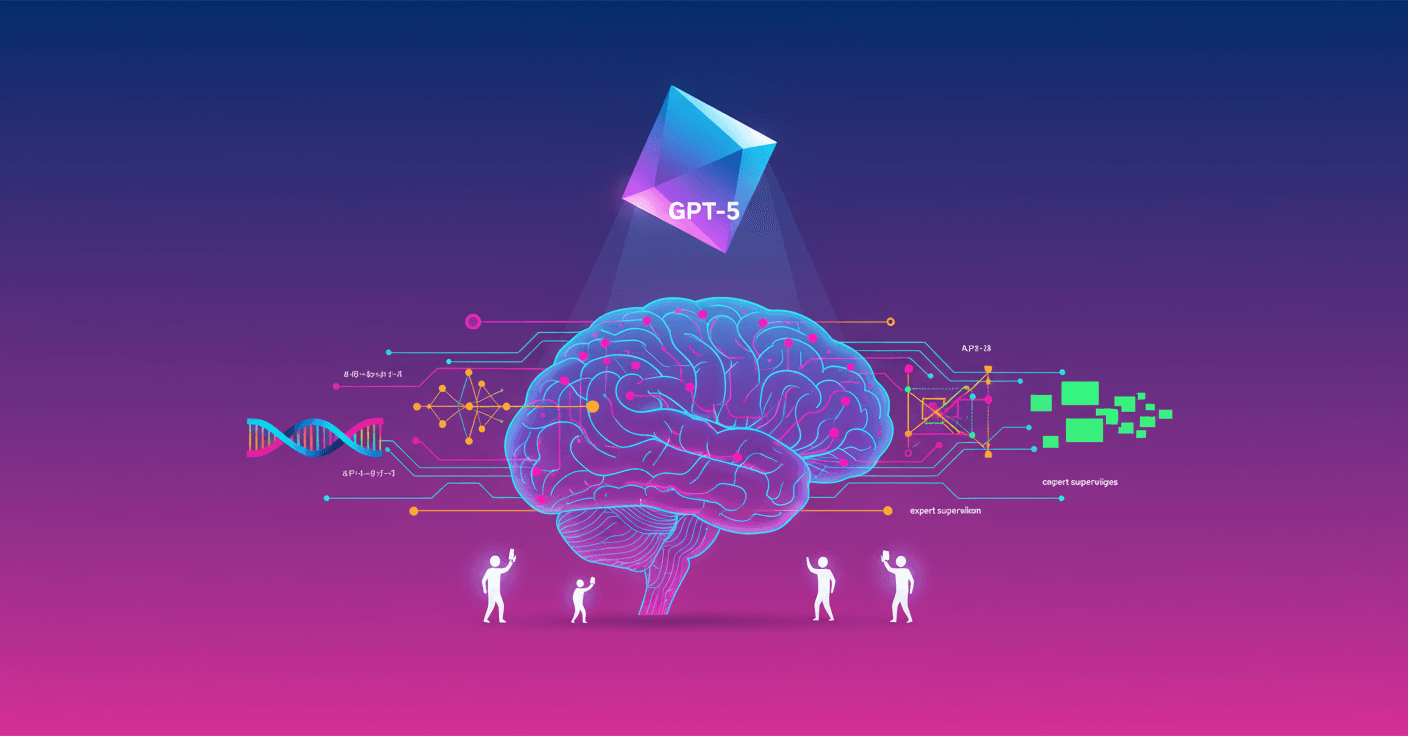
OpenAI says GPT-5 is already helping researchers move faster on problems in mathematics, biology, physics and other fields. It does not work autonomously or replace scientists: it proposes ideas, connects knowledge and suggests experiments that must then be tested separately.
The company has published a paper on early studies conducted with researchers from universities and laboratories including Vanderbilt, Berkeley, Columbia, Oxford, Cambridge and Lawrence Livermore. The cases show what the model can contribute today, but they also make clear that its results are not guaranteed.
From finding connections to completing a proof
One of the most striking examples comes from mathematics. Researchers Mehtaab Sawhney and Mark Sellke were working on a problem posed by Paul Erdős that had remained unsolved for decades. GPT-5 suggested analyzing what happened when a single number deviated from the expected pattern.
That idea helped them find the missing step. The researchers reviewed it, corrected it where necessary and completed a proof confirming Erdős's original conjecture. The model did not produce an answer ready for publication, but it pointed to a direction that proved useful.
In another project, Sébastien Bubeck used GPT-5 to study an optimization theorem. Optimization is the branch of mathematics that looks for the best possible option, such as the shortest route or the most suitable parameters for training a system. The model proposed a more precise condition and a simpler proof, which Bubeck verified manually.
It can also work as a fast critic. Mathematician Tim Gowers gave it combinatorics problems he was working on. GPT-5 detected errors, missing cases and counterexamples in several ideas. It made no progress on other attempts, and Gowers concluded that it is still far from being a complete coauthor.
Potentially saving months in biology
The biology case points to a more practical use. A team led by Derya Unutmaz had spent months trying to explain an unusual change in immune system cells. Based on an unpublished graph, GPT-5 proposed a likely mechanism within minutes and suggested an experiment to test it.
The experiment confirmed the explanation. This kind of help could shorten some stages of medical research, not because the model discovers a treatment on its own, but because it can help move more quickly from a confusing observation to a testable hypothesis.
The model also helped researcher Nikita Zhivotovskiy look for applications of a convex geometry theorem. Instead of simply finding papers with the same words, it connected the result to density estimation, learning theory and multi-objective optimization. It also pointed to references in other languages that the researcher did not know about.
What changes for research
The main value of GPT-5 does not seem to be answering isolated questions, but expanding the number of paths a team can explore. It can help to:
- Review large amounts of literature and find connections between fields.
- Propose proof outlines, counterexamples or mathematical transformations.
- Suggest biological mechanisms and experiments to test them.
- Detect errors and overlooked cases in an idea that is still incomplete.
The difference from a traditional search engine is that the model can connect concepts even when they appear in different disciplines, languages or contexts. But that advantage has an important limit: it can also invent citations, mechanisms or proofs that seem correct but are not.
That is why the process still depends on experts. They decide which problems deserve attention, review the proposals, run the experiments and validate the results. The relationship looks more like working with a very fast collaborator than delegating a project to it.
OpenAI presents these cases as selected examples, not as a complete measurement of GPT-5's performance. The model can get stuck, be sensitive to how a question is phrased or overlook details specific to a discipline. In addition, a promising idea in mathematics can be tested relatively quickly, while a hypothesis in biology may require months of laboratory work.
What matters now is whether these forms of assistance can be repeated reliably across more teams and problems, and whether models improve when they have more time to reason and access to specialized scientific tools. The relevant signal is not that AI can solve science on its own, but that it can verifiably reduce the time between a question, a hypothesis and a confirmed result.