Google rounds up its major AI announcements from November
Google rounds up its November AI announcements, with Gemini 3 at the center. The new features reach Search, Maps, Android Auto, shopping, travel, education, science, and infrastructure.
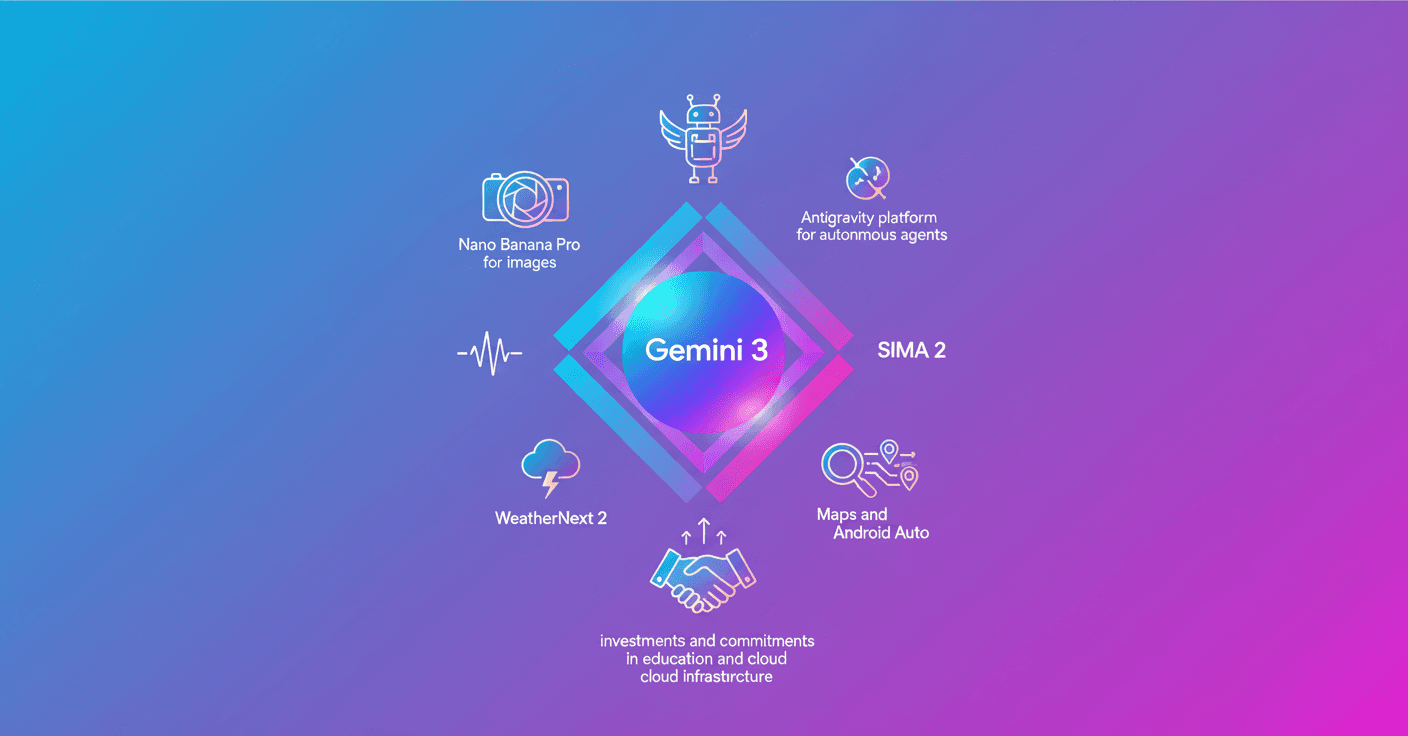
Google closed out November with a long list of artificial intelligence announcements, from Gemini 3 to new tools for searching, traveling, shopping, and coding. The company also unveiled advances in assisted driving, weather forecasting, education, and infrastructure.
The month's focus was Gemini 3, Google's new AI model. The company says it improves its understanding of text, images, and other formats, along with its ability to reason, code, and carry out multistep tasks.
Gemini 3 comes to Search and more tools
Gemini 3 was added to Google Search on day one, starting with AI Mode. According to Google, the model can interpret complex queries and respond with visual layouts, interactive tools, and simulations tailored to each search.
Google AI Pro and Ultra subscribers in nearly 120 countries and territories, in English, can access Gemini 3 Pro through the AI Mode model selector. For you, the shift points to search that relies less on links and focuses more on explanations, comparisons, and concrete plans.
The model also serves as the foundation for other new features. Nano Banana Pro is Google's new image-generation and editing system. It is designed to create more detailed, professional-looking graphics and edit images based on complex instructions.
In coding, Google introduced Antigravity, a platform available in public preview. Rather than simply suggesting or modifying lines of code, its agents can plan a task, carry it out, and check the result. For example, they could build an entire function and verify that it works.
Maps and Android Auto get conversational features
Google Maps will add a conversational driving experience powered by Gemini. You will be able to search for places, report traffic, or ask for suggestions along your route using your voice.
Navigation will also start using landmarks. Instead of only telling you to "turn right in 150 meters," it may tell you to turn after a restaurant or next to a recognizable place. This feature is already rolling out on Android and iOS in the United States, while Gemini in navigation will arrive wherever Gemini is available.
Gemini has also started rolling out to Android Auto, a platform available in more than 250 million vehicles. The idea is to let you add stops, send messages, check email, or create playlists using natural language. Google says you will need to have the Gemini app installed on your phone.
Shopping and travel with AI agents
Google added features for planning trips from Search. With Canvas, inside AI Mode, you can describe the type of trip you want and get a personalized itinerary. The tool also aims to connect recommendations with bookings and deals.
For shopping, AI Mode brings images, prices, reviews, and inventory information together in a single response. Some agents can also call stores to check whether a product is in stock and automatically complete purchases at eligible retailers when the price matches your conditions.
This brings AI closer to tasks that normally require opening many pages, comparing options, and making calls. The important question will be which retailers, countries, and conditions actually allow these automated purchases.
AI for science, weather, and education
Google introduced SIMA 2, an agent designed to interact with virtual worlds. It can follow instructions in natural language, hold conversations, reason about its goals, and improve over time. Google describes it as a step toward more general agents and systems capable of acting in physical or virtual environments, not as artificial general intelligence already achieved.
It also launched WeatherNext 2, its most advanced weather-forecasting model. It generates forecasts eight times faster and at a resolution of up to one hour. Google is already working with weather agencies to support their decisions.
In education, the company announced 30 billion dollars in new funding for learning initiatives. NotebookLM also added tools for creating study cards and quizzes, useful for turning lengthy material into review exercises.
Gemini Live, meanwhile, enables more natural conversations and offers controls such as adjusting speaking speed. Google suggests using it to practice languages, prepare for interviews, or study complex subjects.
More investment in infrastructure
Google announced a 40 billion dollar investment in Texas for AI infrastructure and cloud services. The plan is part of a broader strategy that includes investments in the United States, Europe, Africa, and Asia-Pacific.
The company also plans to train 100,000 electrical workers and create 30,000 learning positions. The goal is to meet demand for data centers, power grids, and other elements needed to expand AI services.
November's roundup shows the direction Google is taking with AI: fewer standalone tools and more features integrated into Search, Maps, cars, shopping, education, and coding. What to watch now is the actual rollout: which countries get these features, what tasks they can complete without help, and what controls you will have before an agent acts on your behalf.