Google recaps 8 AI advances that shaped 2025
Google recaps eight areas where it says it advanced during 2025, from Gemini 3 and content generation to AlphaFold, weather forecasting, robotics and safety. The review shows AI becoming increasingly capable of carrying out tasks, while making clear that its results still require human review.
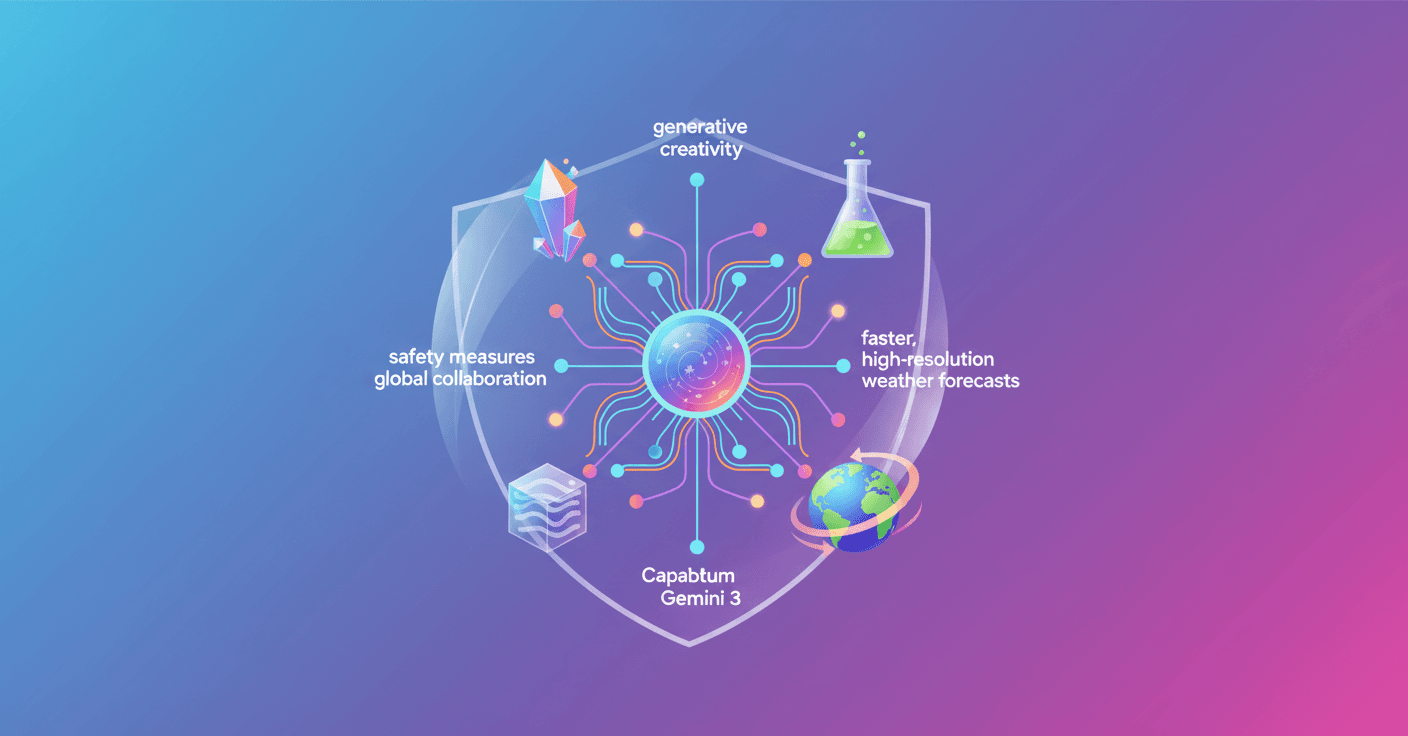
Google presents 2025 as the year artificial intelligence began shifting from a tool you use to a utility you can assign work to. In its annual review, the company brings together advances in models, science, creativity, robotics, climate and safety.
The review reflects Google’s view of its own progress, not an independent evaluation. Even so, it shows where AI is heading: systems that can reason, work across different formats and carry out tasks with less supervision.
1. More reasoning at a lower cost
For Google, the year began with Gemini 2.5, introduced in March, and ended with Gemini 3 in November and Gemini 3 Flash in December. The company highlights improvements in reasoning, image and text understanding, content generation and efficiency.
Google says Gemini 3 Pro led the LMArena rankings and delivered strong results on tests such as Humanity’s Last Exam, GPQA Diamond and MathArena Apex. On the latter, it reached 23.4%, a figure that applies to that specific benchmark, not a general measure of intelligence.
Gemini 3 Flash aims to bring some of those capabilities to a faster, cheaper model. The idea is practical: respond in less time and at a lower cost when you need to summarize documents, analyze data or build an application.
Google also expanded Gemma, its family of lightweight, open models for public use. In 2025, it added multimodal capabilities, more languages, larger context windows and efficiency improvements.
2. AI becomes part of products and software
Google continued adding AI features to products such as Search, Pixel, Gemini and NotebookLM. One of the main directions was so-called agentic AI: systems that do more than respond and can organize steps and collaborate on a task.
In programming, the company introduced Google Antigravity and new Gemini features to help develop software. The change matters because the assistant is no longer limited to suggesting a line of code. It can take part in broader tasks, such as reviewing files, finding errors or preparing a solution.
In NotebookLM and Gemini, features such as Deep Research can gather information and produce more extensive analyses. You still need to review the result, but the initial work can be done in minutes instead of starting from scratch.
3. More tools for creating images, video and audio
Content generation was another major focus in 2025. Google introduced or updated models and products such as Veo 3.1, Imagen 4, Flow, Music AI Sandbox and Gemini’s image editing tools.
The company also highlighted Nano Banana and Nano Banana Pro, names used for its advances in image generation and editing. These tools let you modify a scene, combine elements or create visual assets from written instructions.
Google Labs served as a testing ground for projects such as Pomelli, designed to create marketing content; Stitch, which turns instructions and images into interface designs and code; Jules, a programming agent that works asynchronously; and Google Beam, a video communication platform with three-dimensional imagery.
4. AI for science, health and mathematics
Google DeepMind also applied its models to scientific problems. AlphaFold, the system that predicts protein structures, marked its fifth anniversary and, according to Google, has already been used by more than 3 million researchers in 190 countries.
The company introduced advances such as AlphaGenome for studying the genome, DeepSomatic for identifying genetic variants in tumors and an AI system designed to help scientists propose hypotheses. These are research tools, not automatic substitutes for doctors or laboratories.
In mathematics and programming, Gemini’s Deep Think mode solved problems at a level equivalent to gold medals in two international competitions, according to Google. The figure points to a specific ability in abstract reasoning, not to the system thinking like a person in every situation.
5. Quantum computing, chips and robotics
Google reported advances in quantum computing, including the Quantum Echoes algorithm, which the company considers a step toward practical applications. It also highlighted the Nobel recognition of Michel Devoret, along with John Martinis and John Clarke, for fundamental research into quantum circuits.
In infrastructure, it introduced Ironwood, a processing unit specialized in running AI models. Its design was supported by AlphaChip, a system that helps arrange chip components.
The company also advanced in robotics with the Gemini Robotics and Gemini Robotics 1.5 models, as well as Genie 3, designed to create world models. These systems aim to connect what an AI sees and understands with actions in physical or virtual environments.
6. Weather forecasting and responses to global problems
AI is already being used in areas with direct consequences. Google says its flood forecasting information covers more than 2 billion people in 150 countries for cases involving severe river flooding.
Its WeatherNext 2 model can generate forecasts eight times faster, with a resolution of up to one hour, according to the company. It was also tested to provide different scenarios when forecasting tropical cyclones.
Other projects focus on mapping, wildfires, urban planning, public health and education. In translation, Google brought more advanced models to Translate and began testing speech-to-speech translation.
7. More safety controls and verification
As models generate increasingly convincing content, Google strengthened its safety evaluations. The company describes Gemini 3 as its safest model to date and says it went through the most comprehensive set of tests applied to one of its AI models.
It also added features to verify AI-generated videos and images within Gemini. The benefit is clear: helping you check a piece of content’s origin before sharing it, although no verification tool completely eliminates the risk of errors or manipulation.
Google also continued working on frameworks to assess future risks, including those related to cybersecurity and more advanced systems.
8. More collaboration to build standards
The final theme of the review is collaboration. Google took part in creating the Agentic AI Foundation and supported open standards so agents can connect with different services and tools.
The company also worked with universities, school districts, Raspberry Pi, national laboratories run by the United States Department of Energy and professionals in the creative industries. The goal is for AI to advance not only inside laboratories, but also in education, research and content production.
What you should watch in 2026 is not just whether models achieve better results on a test. The more important signal will be whether they can complete useful tasks from start to finish, with fewer errors, reasonable costs and sufficient controls. Google’s review points precisely to that transition: from talking with AI to delegating real work to it, even though you still need to supervise what it delivers.