Google launches Interactions API for models and agents
Google has introduced Interactions API, a unified interface for using Gemini models and agents such as Gemini Deep Research. The public beta adds context management, background tasks, and connections to external tools, although `generateContent` remains the main option for production.
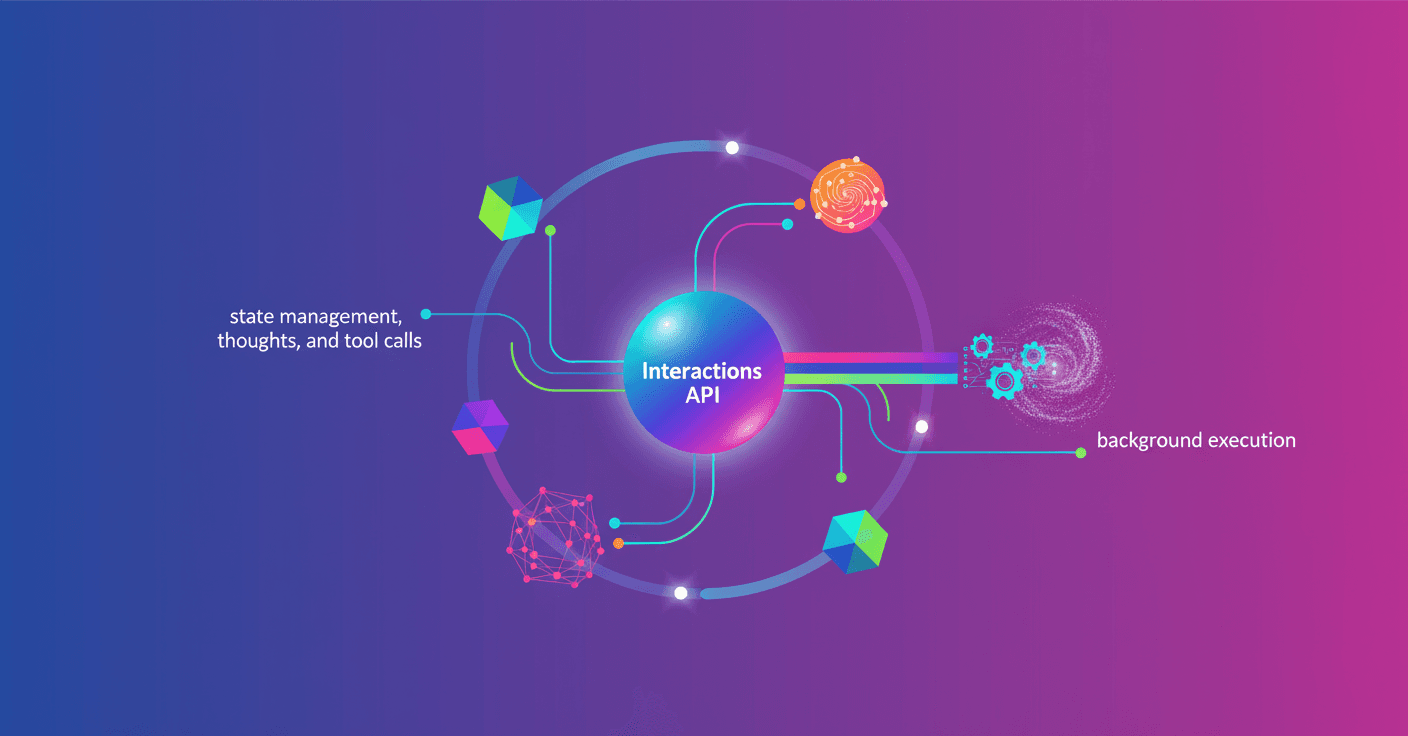
Google has introduced Interactions API, a new interface for connecting models such as Gemini 3 Pro and specialized agents such as Gemini Deep Research through a single access point. It is now available in public beta for developers through the Gemini API and Google AI Studio.
The API is designed for applications that do more than answer a question and stop. An agent can analyze information over a longer period, use tools, maintain a decision history, and combine multiple steps before delivering a result.
One API for models and agents
Interactions API uses a single REST endpoint, /interactions. To work with a model, you specify the model parameter; to use an agent, you specify the agent parameter.
For now, the only integrated agent available is deep-research-pro-preview-12-2025, the preview version of Gemini Deep Research. This agent can conduct lengthy investigations and compile its findings into detailed reports.
Google plans to expand the system so developers can combine three components through the same API:
- Gemini models.
- Google's integrated agents.
- Custom agents created by each company or developer.
What changes when you build AI applications
The API adds capabilities that are difficult to manage with a traditional input-and-response interface such as generateContent.
- Optional server-side state: Google can store an interaction's history so your application does not have to resend and manage it at every step. This can reduce errors and, in some cases, costs through greater use of caching.
- Easier-to-interpret history: Messages, reasoning, tool calls, and results share a common structure. You can debug, modify, or stream them as they happen.
- Background execution: Long-running tasks can continue on Google's servers without your application having to keep a connection open the entire time.
- Support for remote MCP servers: Models can call tools based on the Model Context Protocol directly. MCP is a standard for connecting models to external services.
In practice, this lets you build a tool that researches a market, consults multiple sources, and prepares a report without having to program every intermediate state, retry, and external call separately.
Still not the main option for production
Interactions API is in public beta, so Google warns that it may undergo breaking changes. For more conventional production applications, generateContent remains the recommended option and will continue to receive support.
Developers can already try the new API with a Gemini API key obtained through Google AI Studio. Google has also published its OpenAPI specification and added initial support in the Agent Development Kit and the Agent2Agent protocol.
The company plans to bring Interactions API and Gemini Deep Research to Vertex AI soon, while expanding support in other tools. The important change is the shift in approach: Google is no longer treating models and agents as completely separate products, although the API still needs to mature before it becomes a stable foundation for any critical system.