Google introduces T5Gemma 2, its multimodal AI
Google introduces T5Gemma 2, a family of encoder-decoder models that understands text and images, works with up to 128,000 tokens, and supports more than 140 languages. Its compact versions are designed for developers to adapt to specific tasks and run with fewer resources.
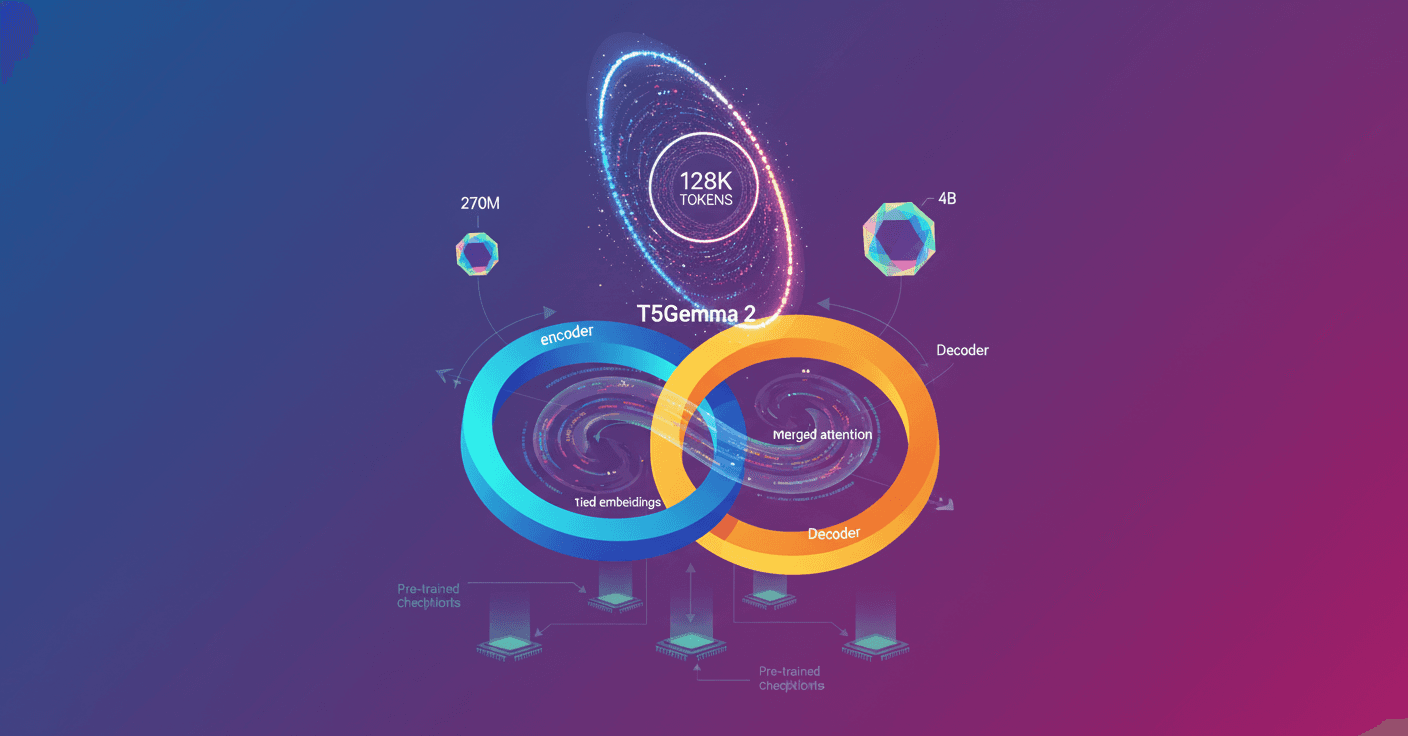
Google has introduced T5Gemma 2, a new family of artificial intelligence models that combines text and images, can work with up to 128,000 context tokens, and supports more than 140 languages. It is based on Gemma 3 and comes in compact sizes for research, development, and on-device use.
Unlike models that generate text from start to finish, T5Gemma 2 uses an encoder-decoder architecture. The encoder analyzes the input, and the decoder produces the response. This separation is useful for tasks such as summarizing documents, translating, answering questions about an image, or processing long texts.
Smaller, more efficient models
The family includes three main configurations:
270M-270M, with around 370 million parameters in total, not counting the visual encoder.1B-1B, with around 1.7 billion parameters.4B-4B, with close to 7 billion parameters.
The two numbers indicate the approximate size of the encoder and decoder. The smallest version is designed for fast experimentation and easier deployment on devices with limited resources.
Google has reduced the architecture's size and complexity with two changes. First, the encoder and decoder share the same word representations, a technique that avoids storing duplicate information. Second, the decoder combines attention over the generated text and attention over the input in a single layer.
According to Google, the result is a model with fewer parameters that is easier to distribute in parallel. In practice, this can help you run AI tasks with less memory and test different applications without always relying on large servers.
Images, long documents, and many languages
T5Gemma 2 includes an efficient visual encoder, so it can analyze images alongside written instructions. For example, it can answer questions about a photograph, extract information from a scanned document, or connect an image with text.
It also significantly expands the amount of information it can receive in a single request. Its context windows reach up to 128K tokens, allowing you to work with long documents, collections of files, or extensive histories without splitting them into as many pieces.
The model was trained to support more than 140 languages. This broadens its usefulness for translation, text classification, and assistants that need to work beyond English.
What the tests show
Google says T5Gemma 2 outperforms equivalent Gemma 3 models in several tests covering multimodal capabilities, long context, programming, reasoning, and multilingual tasks. The company also says that using a separate encoder particularly improves the processing of long texts.
These comparisons require an important qualification: the published results mainly correspond to pretrained models. Google is not releasing checkpoints in this version that have already been fine-tuned for conversation or instructions.
The company did carry out minimal supervised fine-tuning, without reinforcement learning, to illustrate performance after training. Those results are not directly comparable with the pretraining charts because they use different tests.
What changes for you
T5Gemma 2 is not a ready-to-use assistant. It is a foundation that developers can adapt to specific tasks before putting it into production. That could include a system that answers questions about internal manuals, analyzes medical images, or processes contracts in several languages, as long as it is trained and evaluated for that purpose.
The pretrained checkpoints are already available for the community to test and fine-tune. The important question will be whether their smaller size preserves those capabilities when they run on real devices, with your own data and the usual memory and speed constraints.