Google introduces FunctionGemma for on-device AI on mobile devices
Google introduces FunctionGemma, a compact model based on Gemma 3 270M that turns commands into actions on mobile phones and other devices. It can work offline, and its accuracy rose from 58% to 85% in an evaluation after specialized fine-tuning.
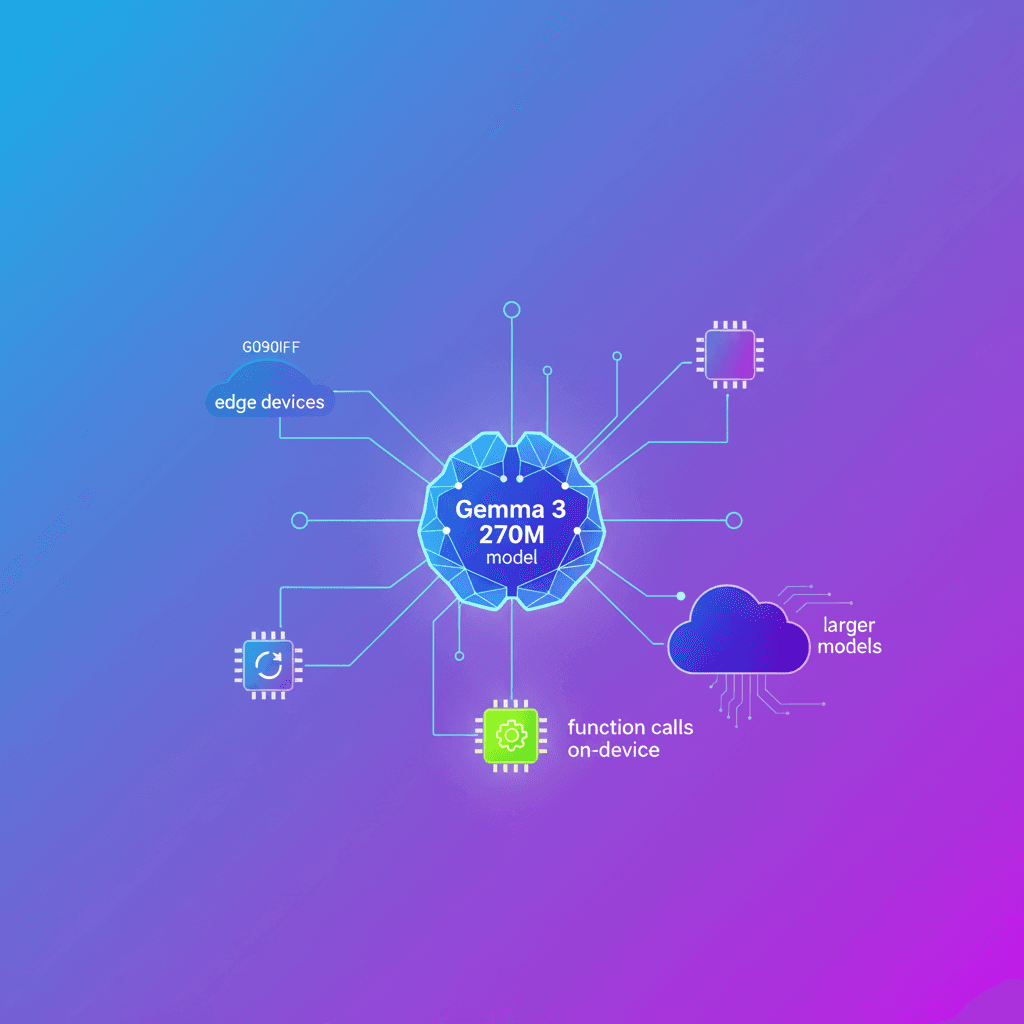
Google introduces FunctionGemma, an AI model designed to turn written or spoken commands into specific actions within an app or device. For example, it can interpret “turn on the flashlight” and call the system function that performs the task, without sending data to a server.
The model is based on Gemma 3 270M, a compact version of Google’s open model family with 270 million parameters. It specializes in what is known as function calling: an AI’s ability to choose and execute software functions instead of simply responding with text.
AI that acts on the device
FunctionGemma is designed for mobile phones, small computers and other edge devices. It can work offline and process commands such as:
- Create a calendar event.
- Add someone to your contacts.
- Turn system settings on or off.
- Control smart devices, media or navigation.
The model can also return to natural language after executing an action and explain the result to you. That combination lets it talk with you while also communicating with the device’s tools.
Local execution offers two clear advantages: lower latency and greater privacy. A simple command does not have to travel to the cloud, wait for a response and return to your phone. More complex tasks can still be sent to a larger model, such as Gemma 3 27B, while FunctionGemma acts as a filter that first handles what can be done directly on the device.
Customization is part of the design
Google does not present FunctionGemma as a model that will perform equally well on any task from the first attempt. Its main purpose is to serve as a foundation that can be adapted to a defined set of functions.
In the “Mobile Actions” evaluation, Google says specialized fine-tuning raised the model’s accuracy from 58% to 85%. The difference shows why, in these systems, training a model with specific examples can be more useful than relying only on general instructions.
In practice, a company could train it on the actions available in its app: booking a table, changing a preference or controlling a camera. The more focused and clearly defined the set of functions, the easier it is to verify what the model can do and how it responds to each command.
Examples in mobile apps and games
Google lets you try these capabilities through the Google AI Edge Gallery app. One example, called Mobile Actions, executes system commands entirely offline. Another, TinyGarden, turns instructions such as “plant sunflowers in the top row and water them” into several game functions, including plantCrop and waterCrop, applied to specific coordinates.
There is also a physics puzzle demo that runs locally in the browser with FunctionGemma and Transformers.js. None of these cases requires a server to interpret the user’s actions.
What this changes for you
FunctionGemma does not turn every phone into a general-purpose assistant capable of solving everything. Its value lies in something more specific: giving existing functions a natural-language interface.
That can make repetitive tasks easier in apps, smart homes, games and business tools. It also allows certain commands to keep working when there is no connection or when the information should not leave the device.
The model can be downloaded from Hugging Face and Kaggle. Google also provides guides for adapting function-calling templates, training the model and deploying it with tools such as LiteRT-LM, llama.cpp, Ollama, MLX and LM Studio.
The next question is how much it improves real products beyond the demos. The approach points to AI that is less focused on conversation and more closely integrated with the specific actions your device already knows how to perform.