Google expands AI to accelerate science and healthcare
Google brings together its AI advances in healthcare, disaster prediction, education, accessibility and work. The company highlights tools that already analyze millions of data points, but acknowledges that their benefits depend on validation, human oversight and more equitable access.
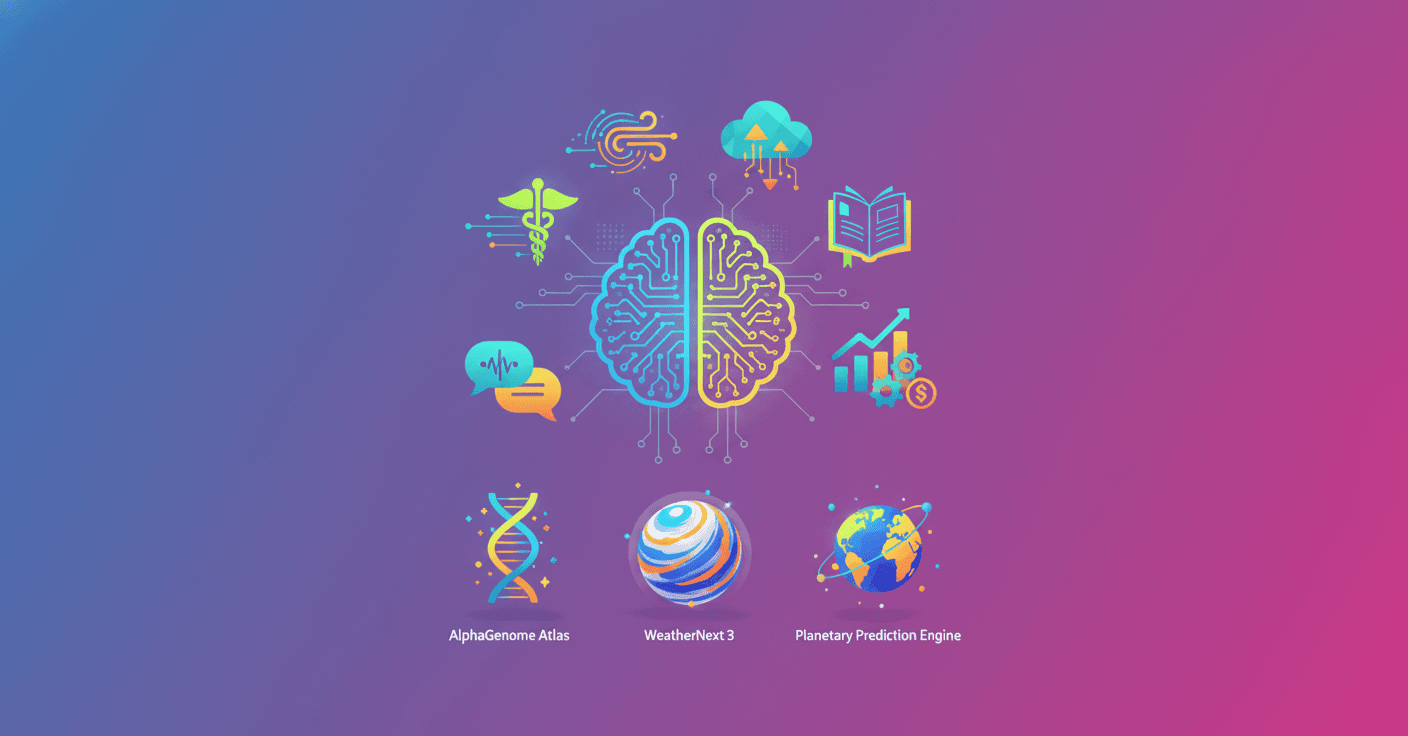
Google has shared an overview of how it is using artificial intelligence to research diseases, anticipate disasters, expand access to education and transform work. The company says its technologies now work in more than 300 languages, spoken by around 7 billion people, or 86% of the world's population.
The announcement does not focus on a single product. It brings together advances developed by Google and its partners in healthcare, climate, learning, accessibility and the economy. It also includes the launch of AI & Economy ATLAS, an interactive tool showing how people are using AI across different countries and activities.
More tools for researching diseases
One of the main goals is to detect diseases earlier and help scientists better understand their causes. Google says AlphaFold, its system for predicting protein structures, has now covered the 200 million structures known to science and is used by 4 million researchers in 190 countries.
The company also introduced AlphaGenome Atlas, which brings together predictions about the 9 billion possible single-letter changes in the human genome. The resource is available to researchers and aims to show how these variations can alter cell behavior.
In tests with Imperial College London and the UK's public health system, an AI tool detected 25% of breast cancers that had not initially been identified in mammograms of 175,000 women. Google stresses that these systems are designed to support professionals, not replace medical diagnosis.
Other projects aim to expand access to basic tests:
- A system for analyzing chest X-rays has reviewed more than 25,000 images at 40 centers in six countries to help detect tuberculosis.
- Its models for identifying diabetic retinopathy have supported more than 1.15 million screenings worldwide.
- The company is working with phones and wearable devices to detect signals linked to cardiovascular disease, hypertension and insulin resistance.
Co-Scientisthelps generate and test hypotheses, such as possible uses of existing drugs against acute myeloid leukemia.
For you, this could mean earlier diagnoses or medical tools becoming available in places where specialists are scarce. But these systems are still under development and need clinical validation, human oversight and clear rules to protect patient data.
Predicting floods, epidemics and other risks
Google is also applying AI to predict natural phenomena and humanitarian crises. WeatherNext 3, its latest weather model, provides precipitation forecasts 50% more accurate one day or more in advance, according to the company. It is already being used in Google products.
The Flood Hub platform now covers at-risk areas in more than 150 countries and reaches around 2 billion people. In 2025, monsoon predictions provided information to 38 million farmers in India. In addition, Google's systems generated more than 520 wildfire alerts that reached over 75 million users.
Another project, Planetary Prediction Engine, combines data on health, food and socioeconomic conditions. Its purpose is to anticipate crises with instructions written in plain language. During the Ebola outbreak in the Democratic Republic of the Congo, Google says it identified 83% of new hotspots in advance. In Nigeria, it doubled the accuracy of local food security forecasts.
These tools do not eliminate the risk of a catastrophe. Their value lies in buying time: issuing warnings earlier, distributing resources more precisely and locating the communities that need help most urgently.
Education and work: opportunities, but also change
Google says AI can personalize learning, translate materials and help teachers with research, preparation and administrative tasks. Its guided learning tools aim to explain complex subjects step by step and in more languages.
The company also acknowledges the problems: errors, academic cheating, loss of critical thinking and unequal access. That is why it is working with ISTE+ASCD to provide AI literacy training to the 6 million teachers in the United States.
In the workplace, Google expects three effects to occur at the same time:
- Some jobs could decline.
- Other jobs will grow.
- Many jobs will change because AI will take over part of their tasks.
The company says it has allocated more than $1 billion to training and upskilling programs, which have reached more than 100 million people. Even so, it acknowledges that more support will be needed to help workers adapt or move to another sector.
More languages and accessibility
Google says its translation systems now help process around 1 trillion words per month and that its goal is to cover the world's 1,000 most widely spoken languages. It has also created voice datasets for African and Indian languages that are underrepresented in technology.
Accessibility includes projects such as SL2T, a model that converts sign language into text. The goal is for AI not only to translate between major languages, but also to work with dialects, regional languages and different forms of communication.
Google presents these advances as a way to accelerate science and improve concrete services. But the company itself acknowledges that the benefits are not guaranteed: AI can fail, widen inequalities or be used harmfully. The next step will be to see which results hold up outside demonstrations, who can access them and what safeguards accompany their deployment.