Google brings Gemini Deep Research AI to developers
Google now lets developers integrate Gemini Deep Research into applications through the Interactions API. The agent conducts multi-step searches, combines documents and web data, and generates reports with citations, while a new benchmark measures its ability to research complex topics.
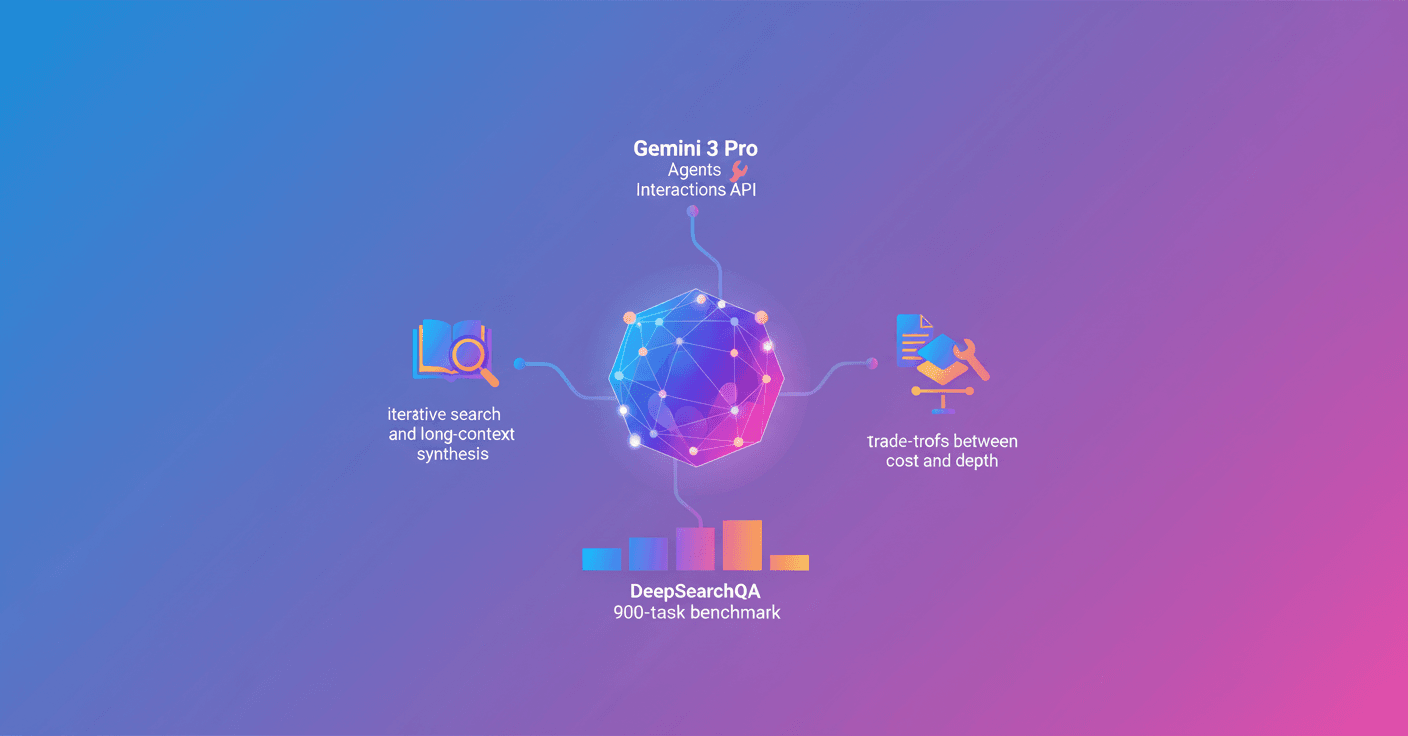
Google has opened Gemini Deep Research to developers through the Interactions API, an interface that lets them integrate its autonomous research agent into their own applications. Until now, this capability was mainly intended for Google products. It can now become part of financial, scientific, business, or educational tools.
The agent does not simply search for an answer and summarize it. It breaks research into steps, formulates queries, reads the results, identifies what is still missing, and searches again. It then brings the information together in a report with detailed sources.
The system is built on Gemini 3 Pro, which Google describes as its most accurate model to date. The company says it trained the model to reduce invented answers, known as hallucinations, and improve report quality on complex tasks. It also says the agent can browse websites more deeply to find specific data.
What results it delivers
According to tests published by Google, Gemini Deep Research achieved these results:
- 46.4% on the full Humanity’s Last Exam benchmark, a test with difficult questions from multiple disciplines.
- 66.1% on DeepSearchQA, Google’s new exam for measuring complex web research.
- 59.2% on BrowseComp, another benchmark focused on searching for and verifying information online.
Google presents these figures as state-of-the-art results, but they come from internal evaluations or evaluations associated with the launch. They do not mean the agent is infallible or can replace human review in important decisions.
The company has also released DeepSearchQA as an open benchmark for other researchers. It includes 900 manually created tasks across 17 areas, where each step depends on the previous analysis. For example, an answer may require finding several pieces of data, relating them to one another, and checking that the final conclusion fits all of them.
The exam aims to measure more than whether the agent gets a single answer right: it measures whether the agent has found all the relevant information. Google observed that performance improves when the system has more time to search and reason, and when it can explore several paths before verifying an answer.
What it can be used for
The value lies in research that usually takes hours before someone can make a decision. A company could request a report on competitors, regulatory risks, and market signals based on internal documents and public sources.
In science, Google mentions Axiom Bio, a company developing systems to predict drug toxicity. According to the company, its initial tests with Deep Research allowed it to review biomedical literature in greater depth and detail during the early stages of research.
The system can combine different types of information:
- PDF documents, spreadsheets, and text files.
- Public data from the internet.
- Files connected through File Upload and File Search Tool.
- Instructions defining the report’s structure, sections, and tables.
It can also deliver results in JSON format, a structure that makes it easier for another application to process them automatically. Each claim can include specific references so the user can check where it came from.
What changes for you
If you use an application that integrates this technology, you could receive reports prepared from your own documents and the web instead of simply having a conversation with a chatbot. For example, a procurement tool could compare suppliers and organize their terms in a table, while an analytics platform could turn research into data ready to use.
Initial access is available through Google AI Studio with a Gemini API key. Google is also preparing a version for Vertex AI, its enterprise-focused platform, along with connections to more data sources through MCP and native chart generation.
The next question is not only how much the agent can search, but also how much it costs and how its reports are verified. For financial, scientific, or legal tasks, finding more information is not enough: you also need to know whether the sources are reliable, whether any important data is missing, and when a person should review the result before taking action.