

Google Brings AI to Disease Research
Google presents a series of AI projects for studying diseases, speeding up genetic diagnoses, supporting mammography and anticipating outbreaks. The results show potential in the lab and in public health, but still require clinical validation and professional oversight.
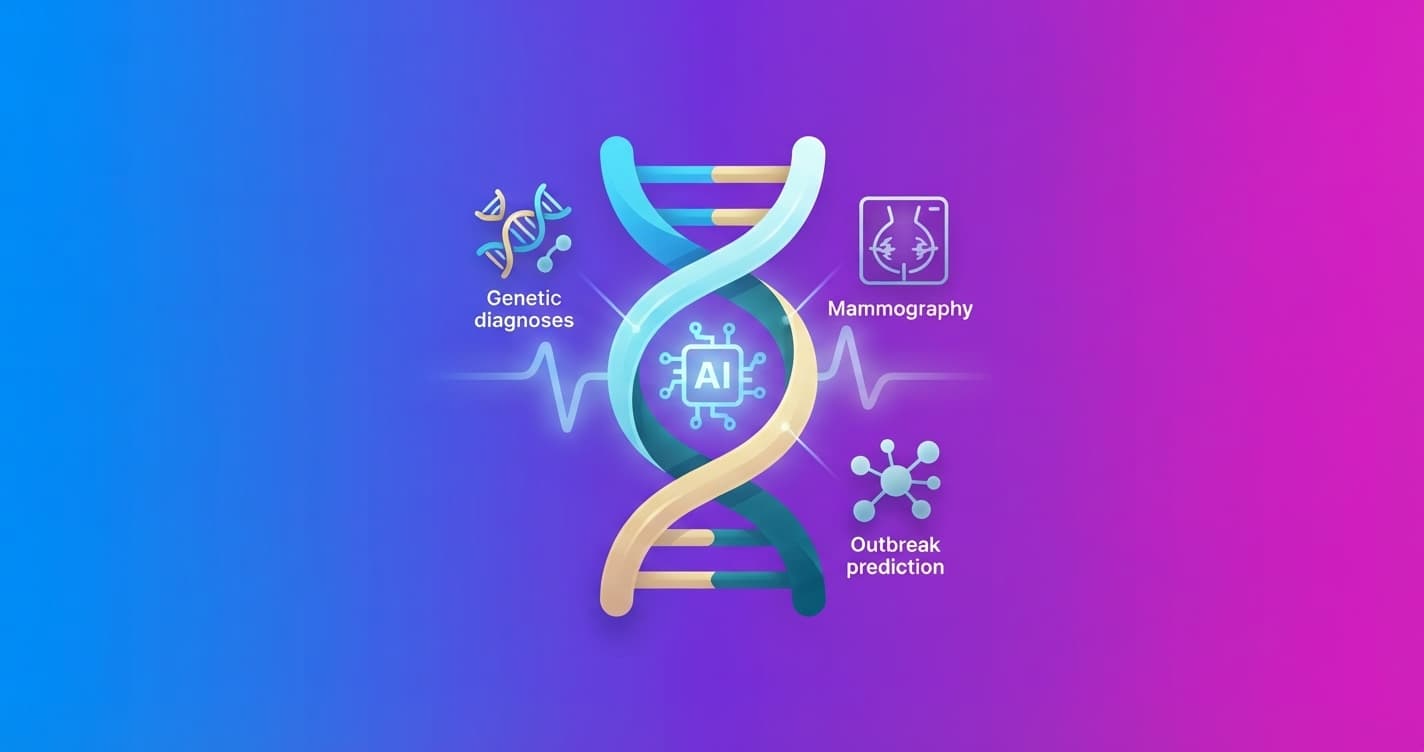
Google is using artificial intelligence to study diseases, speed up diagnoses and help health systems prepare for outbreaks. Over the past five years, its teams have published 90 peer-reviewed studies that have accumulated more than 90,000 citations, according to the company.
The strategy covers the full course of a disease: from understanding what happens inside a cell to supporting medical decisions and anticipating hospital demand. Google says it works with doctors, universities and research institutions so these advances do not remain in the lab.
From genes to treatments
One of the central areas is molecular biology, the study of processes that take place inside cells. Its models are designed to help researchers identify which genetic changes are linked to a disease and how certain treatments might work.
Some examples:
- Researchers at the Institute for Global Health in Barcelona used
AlphaFoldto virtually analyze 30,000 compounds against Chagas disease, which affects around 8 million people. The work identified two FDA-approved drugs that could be repurposed against the disease. - A University of Exeter team analyzed genetic data from more than 54,000 people with
AlphaGenome Atlas. The goal was to separate relevant mutations from the huge volume of genetic changes that do not appear to have major effects. - In collaboration with Jeff Lichtman’s lab at Harvard, Google reconstructed a fragment of the human brain at nanometer resolution and published the data so other researchers could analyze it. It also created maps of the brains of a fly, a young zebrafish and a songbird.
These results are not treatments ready for patients. They are tools for speeding up hypotheses that must later be tested in the lab and in clinical studies.
More speed in the lab and hospitals
AI is also being used to reduce tasks that once required a great deal of time. In a collaboration with Stanford School of Medicine, DeepVariant and DeepConsensus helped produce genetic diagnoses through whole-genome sequencing in less than eight hours in urgent cases. The result was recognized with a Guinness World Record.
Google also introduced AlphaProtein Novo, a system for designing enzymes, proteins that speed up chemical reactions, from scratch. In laboratory tests, it created enzymes capable of making drug components and breaking down toxic plastics under extreme conditions. This is an experimental demonstration, not a general-purpose technology for use in hospitals.
In public health, Google Earth AI models combine geographic, environmental, weather and mobility data. In research by the African office of the World Health Organization and the public health institute of the Democratic Republic of the Congo, geospatial conversational models helped detect the risks of Ebola exposure and transmission earlier. This allowed local teams to deploy mobile laboratories preventively.
Support for diagnosis and health planning
In two studies published in Nature Cancer, Google and Imperial College London evaluated a mammography system with 125,000 women. The system identified 25% of cancers that had historically been missed between screenings and showed the potential to reduce specialists’ reading workload by up to 40%.
That figure does not mean AI will replace radiologists. It indicates that AI could support health systems facing a shortage of specialists, always with clinical validation and professional oversight.
Other projects aim to detect signals that can escape standard analyses. In real cases of childhood leukemia, DeepSomatic confirmed all known variants and found 10 mutations that had not been detected before, even when working with samples containing only tumor tissue. This information could help assess risk and choose targeted treatments, although decisions remain the responsibility of the medical team.
Google also says one of its flu prediction models ranked first in a CDC evaluation for anticipating hospitalizations during the 2025-2026 season. It outperformed 38 other systems and matched the hospital admissions observed.
The company says that in 2026, Google.org allocated more than $60 million to organizations applying these models to disease and public health. The important question now is which tools can maintain their accuracy outside controlled environments, how they fit into real hospitals and what safeguards exist to protect patient data. AI can speed up research, but the decisive step is still proving that this speed safely improves people’s care.