DiScoFormer estimates density and score with a transformer
Ai2 introduces DiScoFormer, a transformer that estimates density and score from a sample without retraining for each distribution. In 100 dimensions, it reduces score error by about 6.5 times compared with KDE and density error by more than 37 times.
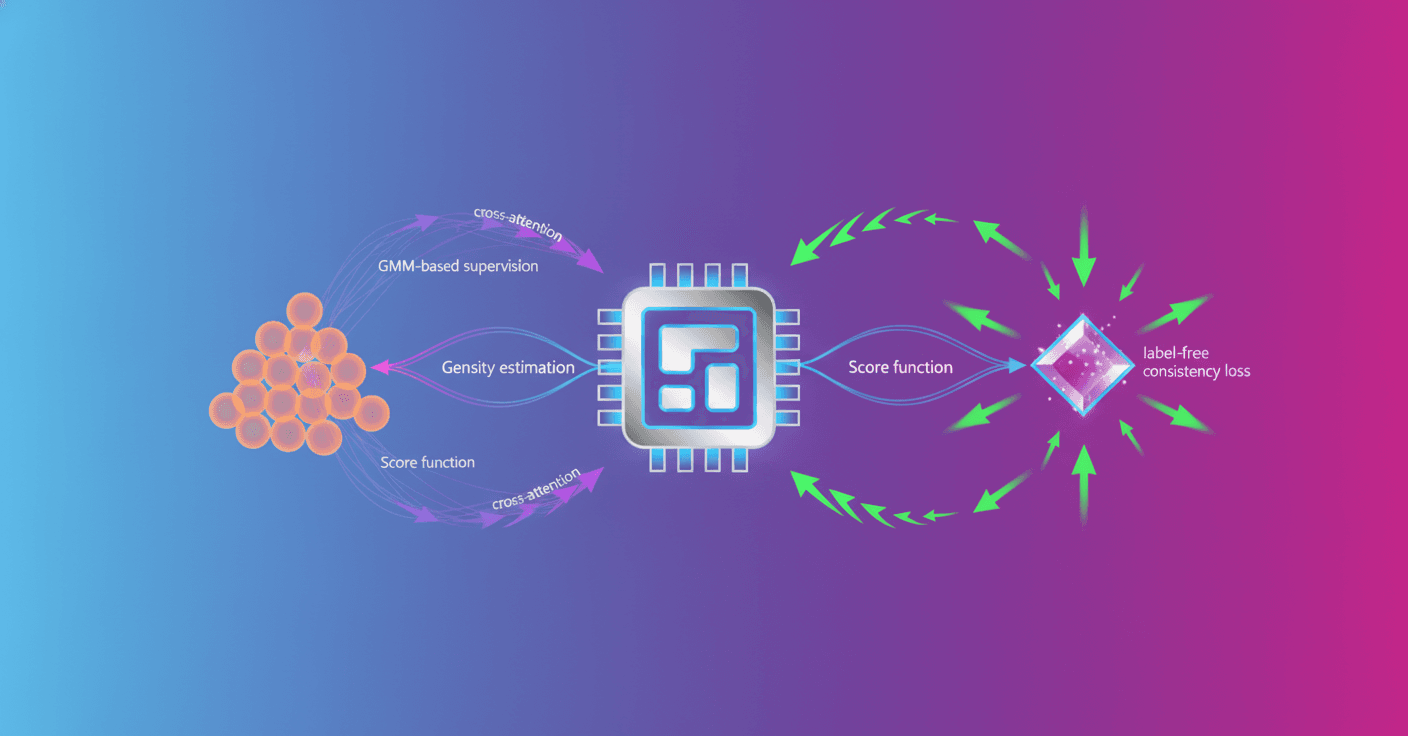
DiScoFormer is a new AI model that estimates, in a single pass, two key properties of a data distribution: its density and its score. Ai2’s proposal aims to replace the current tradeoff between methods that are easy to reuse but less accurate and precise models that must be retrained for each problem.
What DiScoFormer calculates
Imagine a set of points and a question: which areas contain the most data, and which are rare? Density answers the first part. It is a continuous version of a histogram: it rises where there are many points and falls where there are few.
The score is the gradient of the logarithm of that density. In practical terms, it indicates which direction to move in to reach a more probable area. That direction is essential in diffusion models that generate images, but also in Bayesian sampling and scientific simulations, such as those that study plasma.
DiScoFormer takes a data sample and can calculate the density and score at any point, even if that point does not appear in the sample. It does this with a transformer, an architecture that can relate each query to all available data through a mechanism called cross-attention.
The advantage over current methods
One classic method is kernel density estimation, known as KDE. The system calculates density by looking at which points are close to each position. It requires no training and works with many types of distributions, but it quickly loses accuracy as the number of dimensions increases.
Neural models that learn the score tend to perform better in high-dimensional spaces. The problem is that each model must learn a specific distribution and be retrained when the problem changes.
DiScoFormer attempts to combine both advantages:
- It can be reused across different distributions without retraining.
- It estimates density and score with the same model.
- It maintains more stable performance as the number of dimensions grows.
- It includes
KDEas a special case within its architecture.
The researchers show that an attention head can behave similarly to a Gaussian kernel. The difference is that DiScoFormer can learn multiple influence scales and adapt them to the data, instead of using a single fixed distance for every case.
How it learns and adapts
To train it, Ai2 uses Gaussian mixture models, known as GMMs. These are combinations of several Gaussian distributions that can approximate a wide variety of shapes. They also make it possible to calculate both density and score exactly, providing precise targets for training the model.
DiScoFormer shares part of its network between both tasks and uses two outputs: one for density and another for score. Because the score must mathematically equal the gradient of the logarithm of the density, the model can detect when its two predictions do not fit together.
That relationship also helps adapt the model during inference. With the sample fixed, the model takes a few adjustment steps using only this inconsistency, without needing the correct answers. It can therefore correct itself on the fly when it receives data that differs from the examples used during training.
Results in high dimensions
According to Ai2’s tests, DiScoFormer outperforms KDE both when estimating density and when calculating score. In 100 dimensions, it reduces score error by about 6.5 times compared with the best-tuned version of KDE, and density error by more than 37 times.
The model also maintains its accuracy with distributions that have more modes than those seen during training and with non-Gaussian shapes, such as Laplace and Student-t distributions. KDE, however, retains one important advantage: it is usually faster when there is little data.
For you, the importance is not in using DiScoFormer as a standalone application, but in what it could save behind many AI tools. A reusable score estimator could serve as a common component in diffusion generators, Bayesian inference systems, and scientific simulations, without training a new model for each distribution.
The next point to watch is whether this performance holds outside controlled experiments with Gaussian mixtures and in larger-scale real-world problems. The central idea is already clear: one network can learn to read a distribution, measure where its data is concentrated, and indicate how to move toward its most probable regions.