Cohere launches North Mini Code, its AI for coding
Cohere has introduced North Mini Code, an open 30,000-million-parameter model designed for agents that can write code, use terminals and check their changes. The company says it outperforms several open models on software engineering tests and has released it on Hugging Face under the Apache 2.0 license.
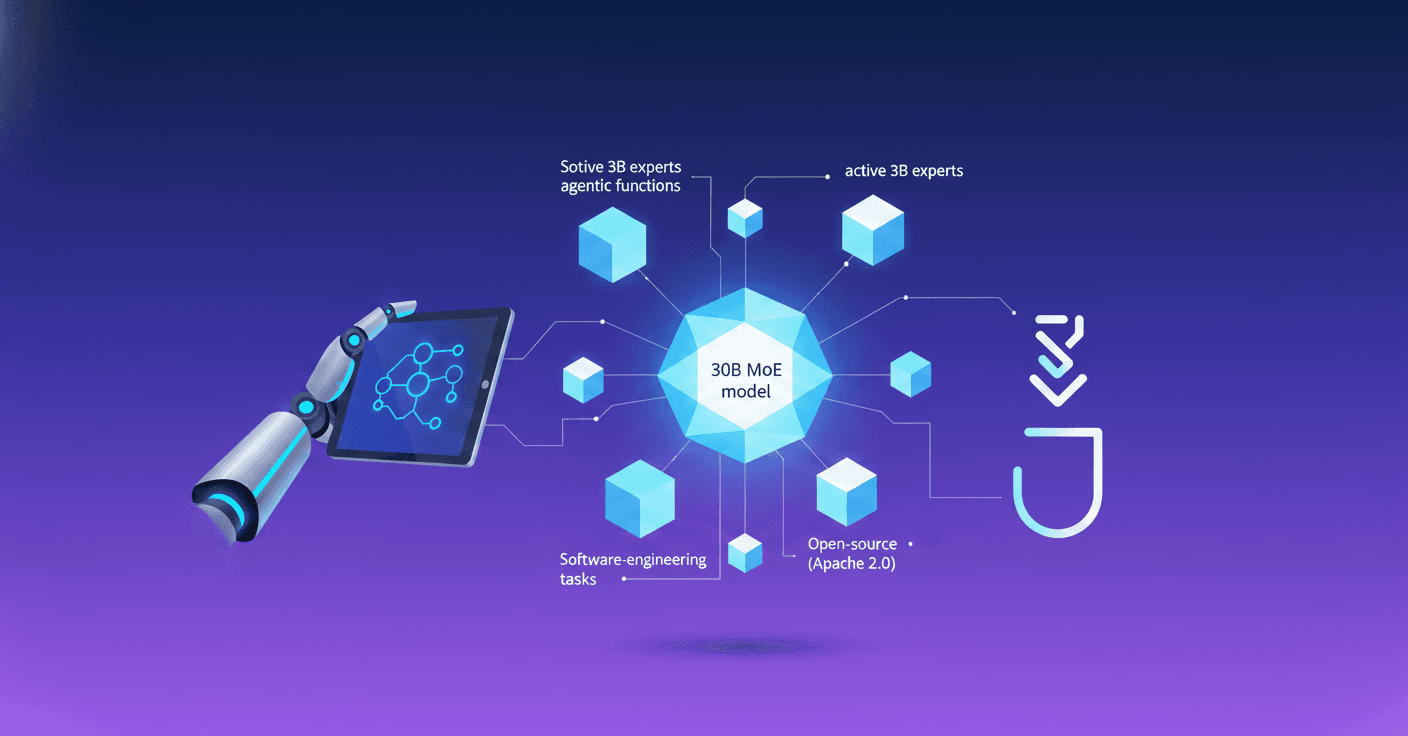
Cohere has launched North Mini Code, an AI model designed to write, modify and test code inside real development environments. It is available on Hugging Face under the Apache 2.0 license, an open license that allows you to use, modify and redistribute it under certain conditions.
The model has 30,000 million parameters, but activates only around 3,000 million for each piece of text. This architecture, called Mixture-of-Experts, divides the work among several internal specialists and activates only those needed at each step. The goal is to offer the capabilities of a large model with a more manageable execution cost.
An AI designed to work with tools
North Mini Code does not just suggest lines of code. Cohere trained it to operate as a coding agent: it can use a terminal, inspect files, edit projects, run tests and fix errors over multiple steps.
That matters because solving a software task rarely means generating an answer and stopping there. For example, an agent can receive an error in an application, locate the responsible file, apply a change, run the tests and try again if something fails.
Cohere says the model scored 33.4 on the Artificial Analysis Coding Index. According to the company, this result surpasses that of several open models of a similar size, such as Qwen3.5 with 35,000 million total parameters and Gemma 4 with 26,000 million, as well as considerably larger models such as Nemotron 3 Super, Mistral Small 4 and Devstral 2.
The comparison depends on the methodology and configurations used in each test. Cohere says it ran its evaluations with three different seeds and reported the average of those results.
Training with projects and terminals
To train the model, Cohere used more than 70,000 verifiable tasks from around 5,000 repositories. Most involved software engineering problems, while the rest were tasks performed directly from a terminal.
The training combined two techniques:
- Supervised fine-tuning, using examples of code, reasoning and tool use.
- Reinforcement learning with verifiable rewards, where the model receives a reward when its changes pass automated tests.
During the first stage, the context extended to 64,000 tokens. In the second, it was expanded to 128,000 tokens, allowing the model to work with very long instructions, files and execution logs.
Cohere also trained North Mini Code with different tool systems. An agent can interact with a complete terminal, a single bash tool or separate functions for editing, searching files and organizing tasks. The company says that adding data from multiple environments improved performance on OpenCode by 10% without reducing the result on SWE-Bench Verified.
Results so far
The initial model, before reinforcement learning, reached 80.2% pass@10 on SWE-Bench Verified and 55.1% on Terminal-Bench v2. pass@10 means that up to ten attempts are generated and the evaluation counts whether at least one correctly solves the task.
After reinforcement training, Cohere recorded absolute improvements of 3 percentage points on SWE-Bench and 7.9 points on Terminal-Bench v2, according to its evaluations. It also observed fewer invalid tool calls, fewer repetitive loops and shorter trajectories.
In an internal human evaluation with 85 samples, the final version was preferred over the version without that training in 66.1% of cases, especially on code-editing tasks.
What this means for you
North Mini Code is aimed primarily at developers and the tools used to build coding agents. You can download its weights from Hugging Face in BF16 and FP8 formats, use it in OpenCode or access it through Cohere's API.
Its main appeal is not just that it generates code, but that it can work inside a project and check whether its changes work. Even so, the results come from benchmarks and evaluations conducted by Cohere, and they do not guarantee that the model will solve every repository without supervision. For important tasks, you will still need to review the code, dependencies and tests.
The next signal worth watching is its performance outside the environments used during training. If it maintains that robustness across different tools, repositories and types of problems, North Mini Code could become a practical component for development agents that are cheaper and easier to run locally.