Anthropic raises $30 billion to expand its AI
Anthropic has raised $30 billion in a round that values the company at $380 billion. It will use the capital to expand Claude, Claude Code and the infrastructure for enterprise customers, a market where it says annualized revenue has already reached $14 billion.
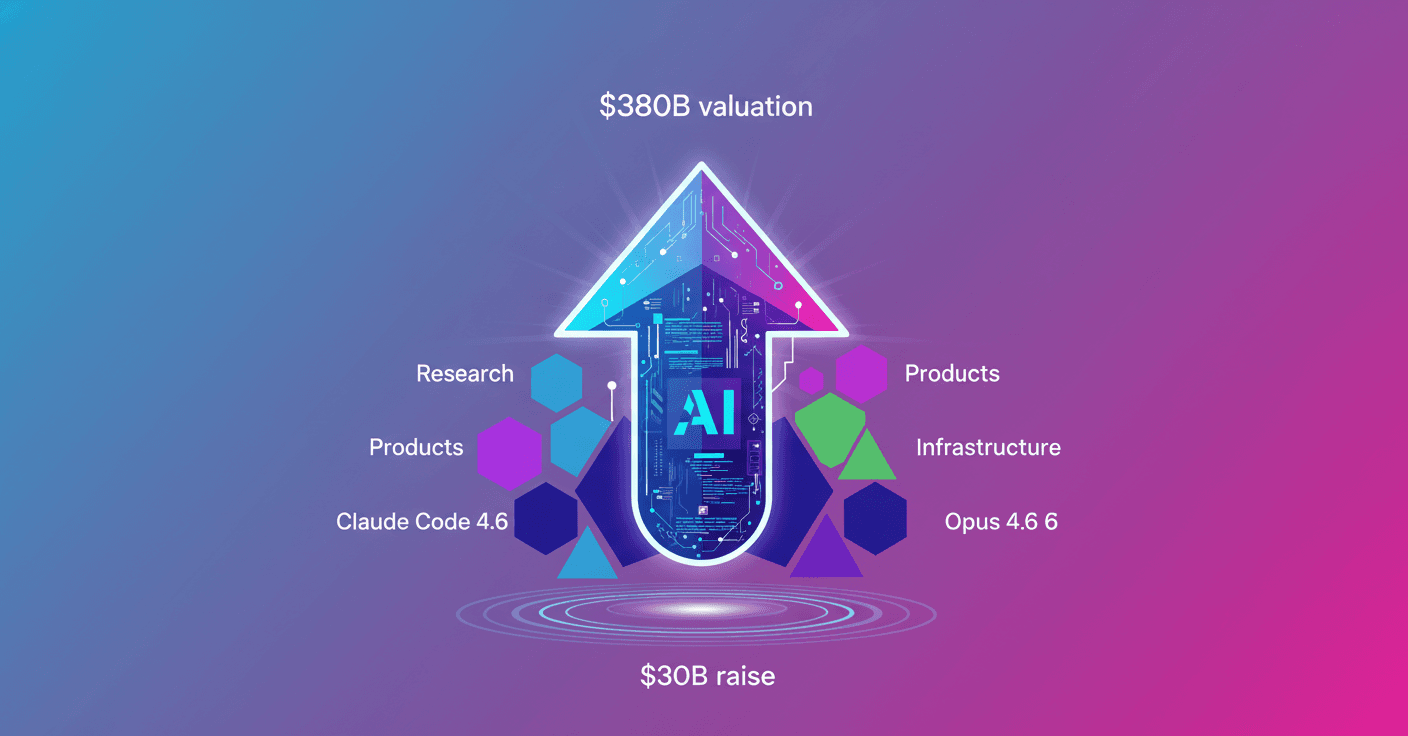
Anthropic has closed a $30 billion funding round that values the company at $380 billion after the investment. The money will go toward expanding its Claude models, enterprise products and the infrastructure needed to run them at scale.
The Series G round is led by GIC and Coatue, with participation from funds including Founders Fund, BlackRock, Goldman Sachs Alternatives, Sequoia Capital, Temasek and Qatar Investment Authority. It also includes part of the investments previously announced by Microsoft and NVIDIA.
The valuation does not mean Anthropic has $380 billion in cash. It is the company’s implied price after adding the new capital. Even so, it shows how strongly investors are betting on AI built for professional work.
Enterprise business grows rapidly
Anthropic says it currently generates $14 billion in annualized revenue, an estimate based on its current revenue run rate, not on what it has collected over an entire year. The company earned its first dollar of revenue less than three years ago.
According to its own data:
- The number of customers spending more than $100,000 a year on
Claudehas increased sevenfold over the past twelve months. - More than 500 companies now spend over $1 million a year, compared with around 12 two years ago.
- Eight of the ten largest companies in the United States, included in the Fortune 10 list, are customers.
The strategy is to turn Claude into a tool integrated across the organization. A company can start by using it to answer questions through an API, automate office tasks or help with programming, then extend it to areas such as finance, sales, cybersecurity or data analysis.
Claude Code becomes a central component
One of the main growth drivers is Claude Code, a product that helps teams create and modify software from instructions. It has been available to the general public since May 2025.
Anthropic says its annualized revenue from Claude Code already exceeds $2.5 billion and has more than doubled since the beginning of 2026. Weekly active users have also doubled since January 1, while enterprise subscriptions have quadrupled.
A recent assessment estimated that Claude Code was writing 4% of all public GitHub commits worldwide, twice as much as one month earlier. A commit is a saved change in a software project’s history. The figure is an external estimate, not a complete measurement of all code being produced.
More than half of Claude Code’s revenue now comes from businesses. The same technology is also being adapted to tasks that do not involve programming, such as preparing reports, spreadsheets and presentations.
More models, tools and infrastructure
Anthropic says it launched more than 30 products and features in January. They include Cowork, which brings Claude Code capabilities to general knowledge work, with open-source plugins for sales, legal and finance teams.
The company has also expanded Claude for Enterprise to healthcare and life sciences organizations operating under HIPAA, the U.S. regulation that protects medical data.
The funding will also allow Anthropic to train and run models in more data centers. Claude is available on the three major cloud platforms: Amazon Web Services, Google Cloud and Microsoft Azure. Anthropic also uses chips from AWS, Google and NVIDIA, a combination that reduces its dependence on any one provider.
For you, the most visible effect may be the arrival of assistants capable of completing entire jobs, not just responding to messages: analyzing documents, preparing a presentation, reviewing code or coordinating steps across several applications. The important question will be how much of that work can be done reliably and with human oversight.
Anthropic is receiving capital to accelerate precisely that transition. Its next results will have to show whether the strong growth of Claude Code and its enterprise customers becomes a sustainable business, rather than just a race to spend more on infrastructure.