Anthropic measures the real autonomy of AI agents
Anthropic analyzed millions of interactions to measure how AI agents are used in practice. Claude Code is working for longer without intervention, while experienced users supervise fewer individual steps and step in when they detect problems. Most actions remain low risk and are concentrated in programming, but uses in healthcare, finance, and cybersecurity are beginning to appear.
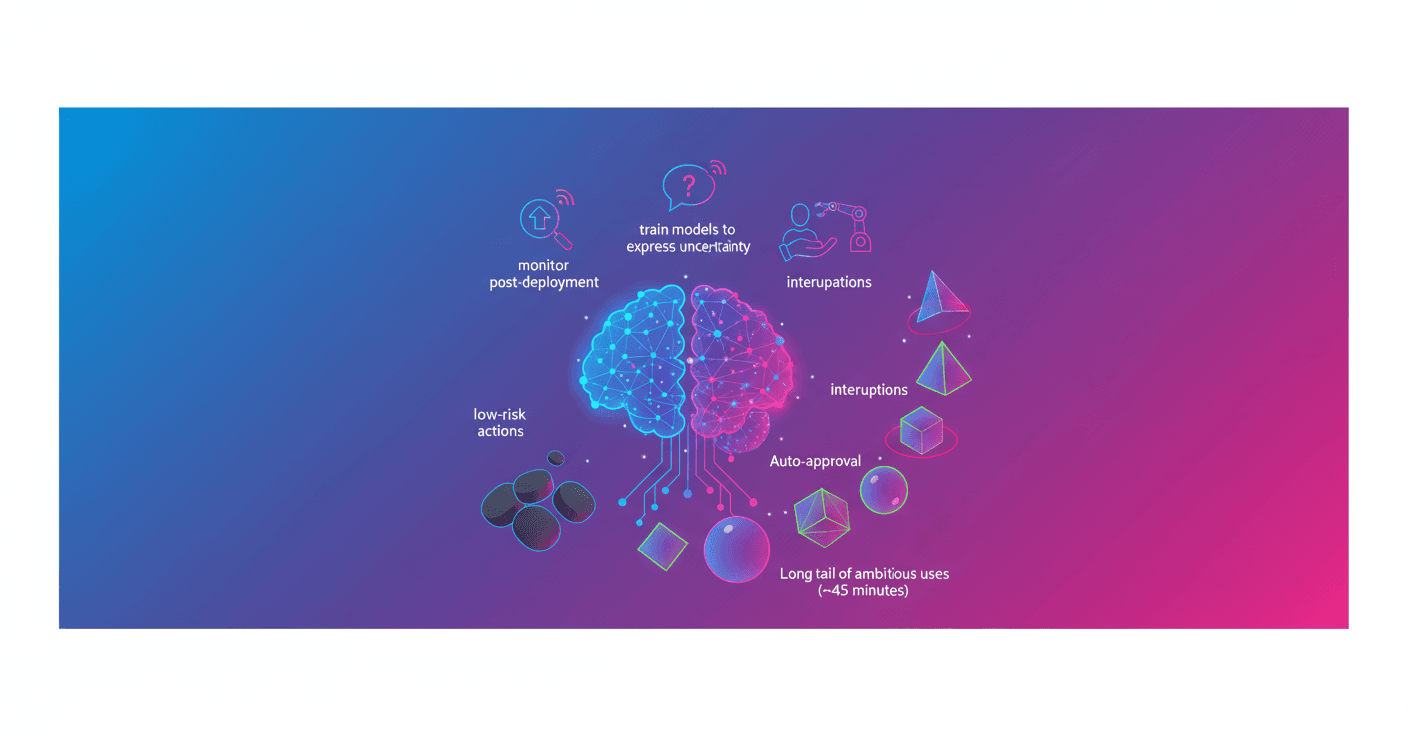
Anthropic analyzed millions of interactions between people and AI agents to measure how long they work without supervision, when users step in, and what tasks they are being used for. The results show adoption still concentrated in programming, but with clear signs that agents are starting to operate for longer periods and in more sensitive areas.
The study, published on February 18, 2026, combines data from Claude Code, Anthropic's coding agent, and its public API. The company defines an agent as an AI system that can use tools to take action, such as running code, querying external services, or sending messages.
Agents work alone for longer
Most Claude Code sessions are still brief: the median duration is around 45 seconds. But the longest sessions tell a different story.
Between October 2025 and January 2026, the 0.1% longest sessions went from lasting less than 25 minutes to exceeding 45 minutes. The increase was gradual and did not coincide with specific new model launches, so Anthropic believes it cannot be explained by improved capabilities alone.
Other factors may also play a role: more experienced users, more ambitious projects, and improvements to the product itself. In fact, Claude Code's user base doubled between January and mid-February, which may also have changed the distribution of session lengths.
Within Anthropic, the success rate on the most difficult tasks doubled between August and December, while the average number of human interventions per session fell from 5.4 to 3.3. The company's reading is that models may be able to handle more autonomy than they currently receive.
Supervision changes with experience
New users typically review and approve every action. Experienced users, by contrast, tend to let Claude work on its own and step in only when they detect a problem.
Specifically, around 20% of sessions from new users use full auto-approval. That figure rises above 40% among users with roughly 750 sessions.
But approving more actions automatically does not mean disappearing from the supervision process. Users with around 10 sessions interrupt Claude in approximately 5% of turns. Among the most experienced users, the figure rises to 9%.
The difference is similar to moving from checking every step taken by an employee to watching the outcome and stopping them when they head in the wrong direction. On complex tasks, approving every action can be too slow or simply impractical.
The AI also asks for help
Claude Code does not stop only when a person interrupts it. It also pauses its work to ask for clarification, present several options, or request information it needs.
On the most complex tasks, it asks for clarification more than twice as often as it does on simple tasks, and it does so more frequently than users interrupt the agent. The most common reasons Claude stops are:
- Presenting the user with different ways to continue: 35%.
- Collecting test results or diagnostic information: 21%.
- Clarifying incomplete or ambiguous instructions: 13%.
- Requesting credentials, permissions, or access: 12%.
- Getting confirmation before acting: 11%.
This matters because a safe agent should not simply follow orders. It also needs to recognize when it does not have enough information and ask before moving forward. That does not guarantee it will always ask at the right moment, but it adds a layer of control that does not exist in a system that acts without stopping.
Most uses are low risk, for now
On Anthropic's public API, almost half of agent activity involves software engineering. Other uses include customer support, business intelligence, sales, finance, e-commerce, healthcare, and cybersecurity, although none of those sectors accounts for more than a few percentage points.
Anthropic estimates that:
- 80% of tool calls have some type of protection, such as restricted permissions or human approval.
- 73% appear to involve a person in some way.
- Only 0.8% of actions appear to be irreversible, such as sending an email to a customer.
The company warns that these figures should be interpreted carefully. Its systems cannot always tell whether an action took place in production, during a test, or as part of a security exercise. In addition, the risk and autonomy scores were estimated by Claude, not through a complete human review.
That is why the higher-risk examples include actions such as accessing medical records, carrying out financial transactions, or deploying changes to live systems. These uses are still uncommon, but a single mistake can have significant consequences.
What changes for you
An agent's autonomy does not depend on the model alone. It emerges from the combination of three elements: what the model can do, the user's trust and experience, and the tools the product provides to approve, observe, or stop actions.
For you as a user, this means effective supervision does not necessarily involve approving every step. It may be more useful to have a clear view of what the agent is doing, receive alerts when a sensitive decision arises, and have a simple button to stop it or change its instructions.
Anthropic is asking developers to invest in monitoring after launch, not just in pre-release testing. It also recommends training models to express uncertainty and avoiding rigid rules that require a person to approve absolutely every action.
The study covers only Anthropic's data and a specific period, from late 2025 to early 2026. Even so, it points to an important trend: agents are still used mainly for programming and reversible tasks, but the boundary is moving toward more autonomous operations with greater impact. The key will be measuring that shift in the real world before systems start acting in ways no one can explain, either in terms of what they did or why.