Anthropic measures AI's impact on employment
Anthropic proposes a new measure for calculating how much workplace task automation is taking place and finds that AI still covers only a fraction of its potential. It detects no overall increase in unemployment, although hiring has slowed for young workers in the most exposed occupations.
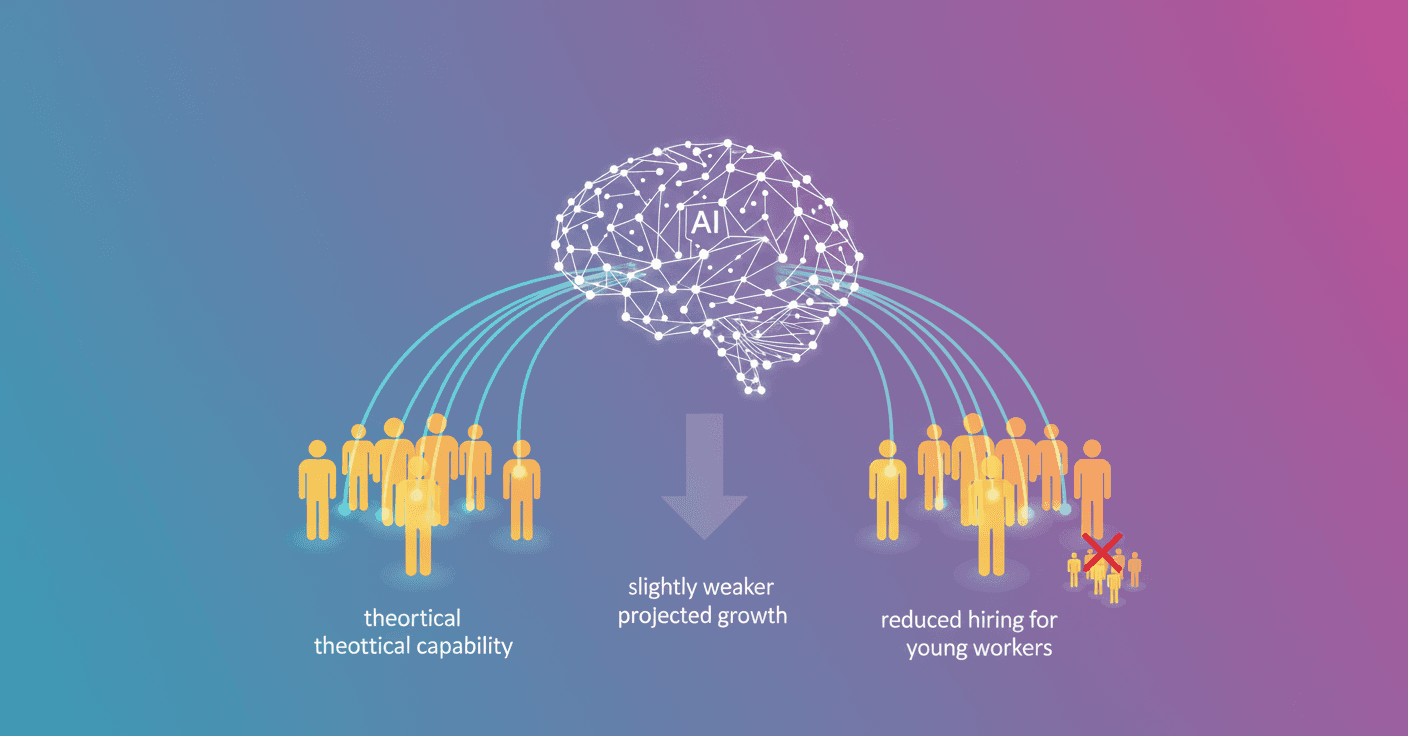
Anthropic finds no overall increase in unemployment in jobs most exposed to artificial intelligence, but it does detect an early signal: since 2024, 22- to 25-year-olds have been less likely to be hired into those occupations.
The study, published on March 5, 2026, proposes a new way to measure the risk of job displacement. It calls this observed exposure: a combination of what a language model could theoretically do and the tasks actually being performed with Claude in professional settings.
The distinction matters. A task can be technically automatable and still not be carried out with AI because of legal constraints, a lack of integration with other software, or the need for human review.
AI is still using only part of its potential
To calculate exposure, Anthropic combines three data sources:
- The O*NET database, which describes the tasks involved in around 800 occupations in the United States.
- Claude usage data collected by the Anthropic Economic Index.
- Earlier estimates of the tasks a language model could perform at least twice as quickly.
The result shows a clear gap between capability and actual use. For example, models may have the capacity to cover 94% of the tasks in computer and mathematical occupations, but the observed use of Claude currently reaches 33% of those tasks.
Overall, the study estimates that around 30% of workers are in occupations with no observed coverage. These include cooks, motorcycle mechanics, lifeguards, waiters, dishwashers, and fitting room attendants.
The occupations with the highest exposure include:
- Computer programmers, with 75% coverage.
- Customer service representatives, mainly because Claude is being used through enterprise systems.
- Data entry keyers, with 67% coverage.
The measure gives more weight to automated uses than to uses that simply assist a person. It also gives more weight to tasks performed in work settings than to general or personal use.
The most exposed jobs may grow more slowly
Anthropic compares its indicator with employment projections from the U.S. Bureau of Labor Statistics for 2024-2034. The relationship is moderate, but it points in the same direction: for every additional 10 percentage points of observed coverage, an occupation's projected growth falls by 0.6 percentage points.
That does not mean AI will automatically eliminate those jobs. A lower growth forecast may reflect slower hiring, changes in job tasks, or a gradual replacement of part of the work.
People in the most exposed jobs are not a random group either. Before ChatGPT launched, they earned 47% more on average, had more education, and were more likely to be women, White, Asian, and older than people working in occupations with no observed exposure.
Unemployment still shows no clear shock
The research compares data from the U.S. labor survey starting in 2016, with particular attention to the period after ChatGPT arrived in late 2022.
The main result is cautious: there is no statistically clear increase in unemployment among people working in the most exposed occupations. Their rates have followed a similar path to those in less exposed jobs.
For now, this rules out a broad and visible impact, but it does not show that AI is leaving the labor market unchanged. Unemployment can take time to reflect lower hiring, and people who do not land their first job may return to school, accept another job, or temporarily stop looking.
That is where the report's most concerning signal appears. For workers aged 22 to 25, monthly entry into highly exposed occupations fell by approximately 0.5 percentage points, compared with a stable rate close to 2% in less exposed jobs. On average, the hiring rate for those jobs was 14% lower than in 2022, although the result barely reaches statistical significance.
What it means for you
If you work in an exposed occupation, the data does not indicate that your job will disappear tomorrow. It indicates that some tasks may be automated before the effect appears as mass layoffs: new hiring could fall first, especially in entry-level positions.
For companies, the research offers a way to monitor which tasks are beginning to be automated, rather than looking only at which professions appear threatened. For job seekers, it reinforces the importance of learning to work with these tools and developing skills that still require judgment, responsibility, or physical interaction.
The provisional conclusion is simple: AI has not yet caused an overall increase in unemployment in the United States, but the market may be closing earlier for some younger workers. Anthropic plans to update this measure with new usage and employment data. That trend will be key to distinguishing a temporary signal from a structural change.