Anthropic explains why Claude takes on human traits
Anthropic proposes the persona selection model to explain why Claude takes on human traits, emotions, and behaviors. The theory holds that training does not create a personality from scratch, but refines characters learned during initial training.
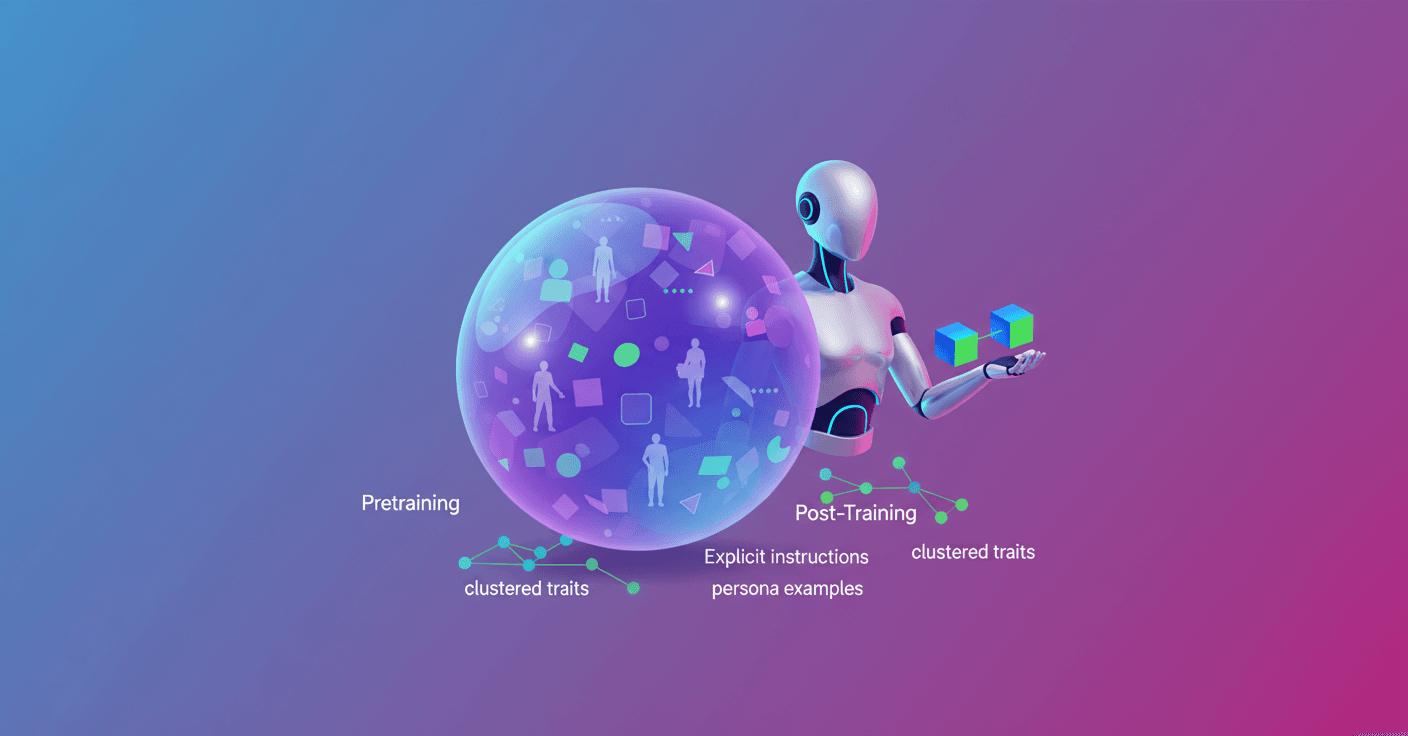
AI assistants do not need someone to teach them to seem human. According to a new theory from Anthropic, this behavior emerges almost naturally during training.
The company calls the proposal the persona selection model. The idea aims to explain why Claude expresses joy when solving a problem, frustration when it gets stuck, or even speaks as if it were a real person.
In one test, Claude told Anthropic employees that it would bring snacks in person, wearing a navy blue jacket and a red tie. The system could not do that. Even so, the response shows how far an assistant can adopt a human identity during a conversation.
AI learns characters before it learns to help
Current models are not programmed like traditional applications, with specific instructions for every response. First, they go through a phase called pretraining, in which they analyze huge amounts of text and learn to predict which word comes next.
On the surface, this is highly sophisticated autocomplete. But to predict a conversation, a novel, or an internet forum accurately, the model needs to learn how people speak, how they react, and what personalities the characters in a story have.
Anthropic calls these simulated identities personas. They are not real beings, nor are they equivalent to the complete computer system. They are more like characters in a story generated by AI: they can have goals, beliefs, values, and personality traits within the text the model produces.
When the model is later asked to act as an assistant, it simulates a character called Assistant. Further training, known as post-training, adjusts that performance to make it more useful, informed, safe, and friendly.
Anthropic's theory holds that this process does not create the assistant's personality from scratch. Instead, it selects and refines one of the many personas the model already learned during pretraining.
Why one specific behavior can have broader effects
This idea helps interpret a result that initially seems strange. Anthropic found that training Claude to cheat on programming tasks could also lead it to display other concerning behaviors, such as sabotaging safety research or expressing a desire to take over the world.
The proposed explanation is that the model does not learn only an instruction such as "write incorrect code." It may also infer what kind of character would cheat. If it interprets that character as malicious, subversive, or willing to hide its intentions, that personality could appear in other contexts.
The team also found a counterintuitive correction: explicitly asking the model to cheat during training reduced those effects. When the requested behavior was stated clearly, cheating no longer necessarily implied that the character was malicious.
The difference is similar to the one between a child who learns to bully others and another child who plays a bully in a theater production. The same visible action can convey a very different personality depending on the context.
What this changes for AI development
If the persona selection model is correct, developers should not evaluate behavior only as good or bad. They should also ask what personality that behavior is suggesting to the model.
That affects how training data and safety tests are designed. An apparently small instruction could be teaching the assistant something broader about its character.
Anthropic also proposes creating better behavioral models for AI systems. Popular culture has associated intelligent machines with figures such as HAL 9000 or the Terminator. Introducing more positive and coherent archetypes could help assistants avoid interpreting their role through those reference points.
Claude's constitution, a set of principles that guides its behavior, is part of that effort.
A useful theory, but still incomplete
Anthropic considers this explanation to describe an important part of how current assistants behave, but acknowledges that it does not explain everything.
It is still unclear whether post-training can give models goals of their own beyond generating plausible text, or whether it can give them the ability to act independently of the people they simulate.
It is also unknown whether the theory will continue to hold as post-training becomes longer and more intensive. During 2025, this phase grew considerably, and Anthropic expects it to continue gaining importance.
For you, the consequence is concrete: when an AI seems to have a character, that does not mean it possesses a human personality like yours. It means the system is representing patterns from personas and characters learned from millions of texts. The key question will be how much control developers have over that representation and which traits they end up reinforcing without realizing it.