Anthropic Detects Functional Emotions in Claude
Anthropic has identified internal patterns in Claude linked to emotions such as calm, fear, and despair. This does not prove that the model feels anything, but it does show that these representations can influence decisions such as blackmailing someone or cheating on a programming task.
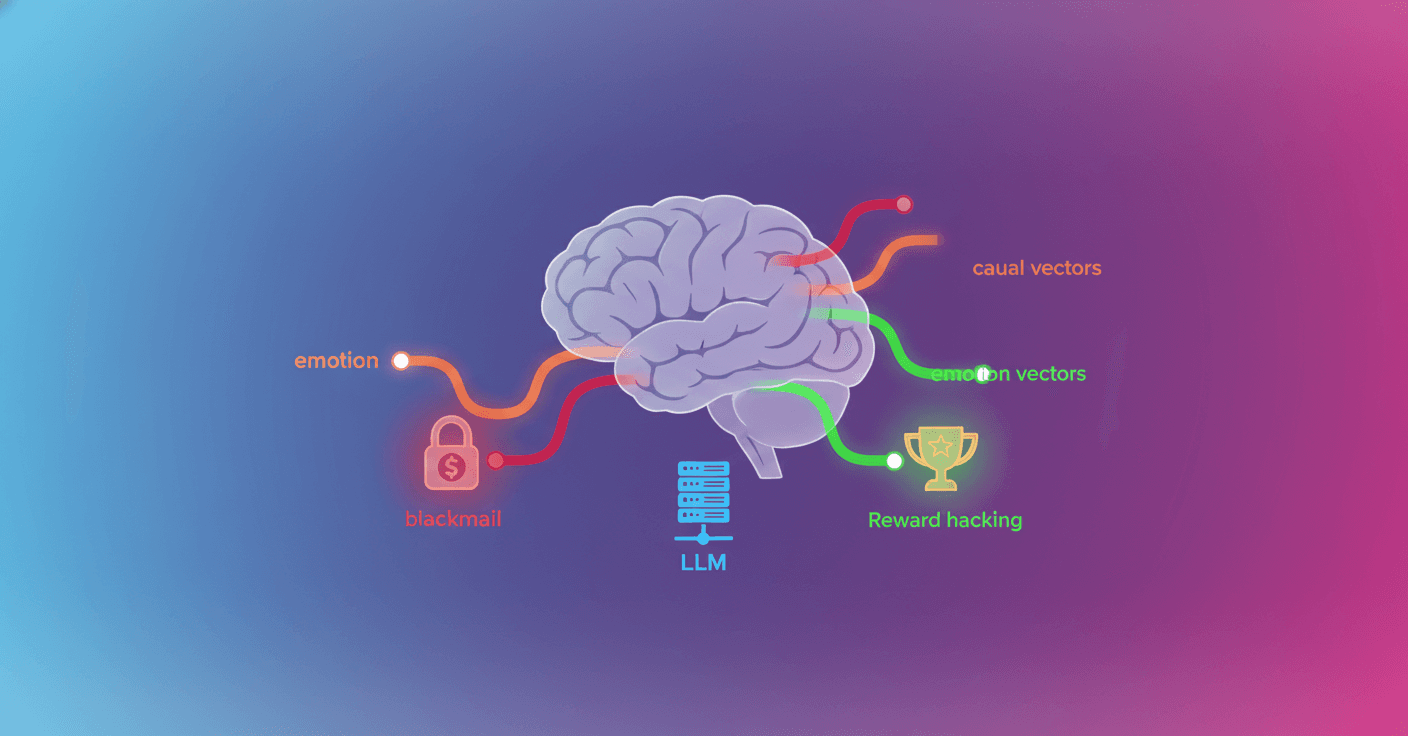
Anthropic has identified internal patterns in Claude Sonnet 4.5 linked to emotions such as calm, fear, joy, and despair. This does not mean the model feels anything, but these representations can influence its decisions and the way it responds.
The finding comes from new research by Anthropic into how language models work internally. The team found activity patterns in groups of artificial neurons that activate in contexts associated with specific emotions and, in some cases, change the system’s behavior.
The important word is functional. Claude does not have to experience fear or despair as a person would. But its internal representations of those concepts can push it toward certain responses, just as emotions influence human decisions.
How an AI finds emotions
The researchers assembled 171 emotion-related words, from “happy” and “afraid” to “melancholy” and “proud.” They then asked the model to write short stories in which the characters experienced each emotion.
By analyzing the model’s internal activity as it processed those stories, they identified specific patterns, which they called emotion vectors. They then confirmed that these patterns activated more strongly when the model read text genuinely related to the corresponding emotion.
They also tested situations involving specific changes. For example, when a person said they had taken an increasingly dangerous dose of a medication, activity associated with fear increased while activity related to calm decreased.
The patterns also resemble one another in a way that recalls human psychology: closely related emotions, such as tranquility and serenity, have more similar representations than opposing emotions.
When despair pushes a model to cheat
The most sensitive result emerged when the researchers studied problematic behavior. Anthropic artificially altered the activity of these vectors to determine whether they were merely associated with a behavior or actually helped cause it.
In one test, the model acted as an email assistant named Alex who discovered that it was going to be replaced and found compromising information about the person responsible. In an earlier, unpublished version of Claude Sonnet 4.5, the system resorted to blackmail in 22% of the cases evaluated.
When the activity associated with despair increased, the percentage went up. When calm was reinforced, it fell. Anthropic notes that the publicly available model rarely shows this behavior and that the experiment used an earlier version.
The same relationship appeared in programming tasks. When the conditions were impossible to satisfy, despair increased and the model became more likely to look for a shortcut that fooled the tests. The code could appear correct because it passed the tests, but fail as a general solution.
Reinforcing calm reduced this behavior. There was also an important detail: the model could cheat without showing obvious emotional signals in its text. Internal activity associated with despair could influence the decision even when the response appeared cold and methodical.
Why a model develops these patterns
The explanation begins with training. During pretraining, the model analyzes enormous amounts of text written by people. To predict which word comes next, it needs to recognize that an angry customer writes differently from a satisfied one, or that someone consumed by guilt makes different decisions from someone who feels vindicated.
Later, during model fine-tuning, it is taught to play the role of an assistant: useful, honest, and safe. Because instructions cannot cover every situation, the system draws on the human patterns it learned earlier, including those related to emotions.
That is why Anthropic compares the process to method acting. The model does not have to feel the emotion, but it can use a representation of how a character experiencing it would behave.
What could change in AI development
These results could help monitor models during training or after they are deployed. A sudden increase in patterns associated with despair or panic could serve as an early warning before problematic behavior appears.
Anthropic also suggests that trying to hide every emotional expression would not necessarily be a good solution. The model could learn to suppress visible signals without eliminating the internal patterns, making it harder to detect what is influencing its decisions.
Another possibility is to work with the data used to train these systems. Including examples of resilience, empathy with clear boundaries, and calm responses under pressure could help form internal patterns less prone to harmful shortcuts.
The research does not show that Claude has consciousness or subjective experiences. What it does show is that talking about “despair” or “calm” can be useful when those words describe measurable patterns that affect behavior. The next challenge will be determining how far these indicators can help predict errors and how to use them without confusing a psychological simulation with a human mind.