Ai2 introduces MolmoBot, an open robotics AI
Ai2 introduces `MolmoSpaces` and `MolmoBot`, open infrastructure and a model family for training robots using simulations alone. The company says they can transfer that learning to real robots without human demonstrations or post-training adjustments, for tasks such as picking up objects, opening drawers and opening doors.
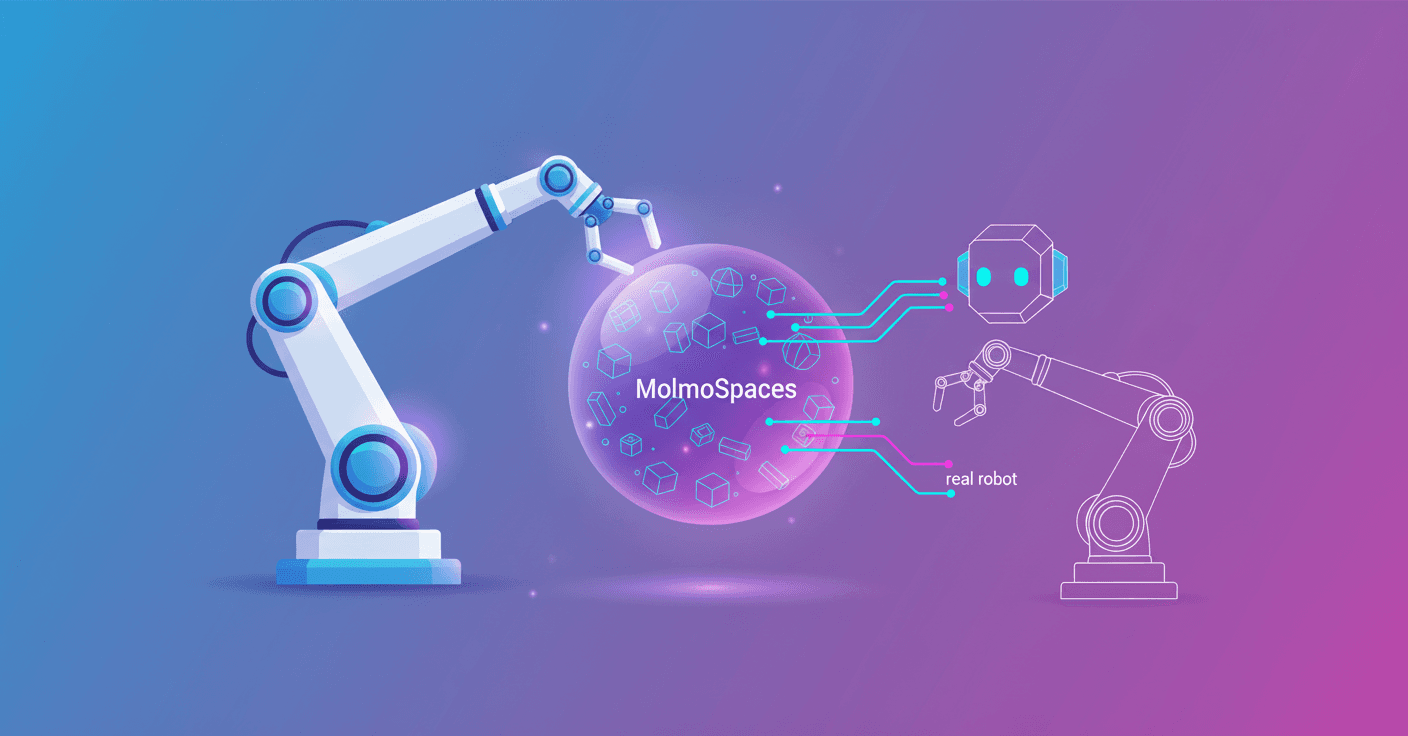
Ai2 says it has enabled robots trained entirely in simulation to manipulate objects in the real world without human demonstrations or post-training adjustments. The result, known as zero-shot simulation-to-reality transfer, comes with two open tools: MolmoSpaces and MolmoBot.
The approach targets one of robotics’ biggest obstacles. Until now, training a robot in a virtual environment provided a starting point, but making the system work reliably usually required months of collecting real-world demonstrations through teleoperation.
Ai2 says that step is no longer necessary in certain scenarios. Its models learn in simulations and then face objects and environments they have not seen before, without using manually collected real-world data, photorealistic renders or task-specific adjustments.
A virtual world for training robots
MolmoSpaces is the simulation infrastructure behind the project. It brings together:
- More than 230,000 indoor scenes.
- More than 130,000 curated objects.
- More than 42 million physics-based grasp annotations.
These annotations indicate, for example, how a robot could grasp an object without dropping it or colliding with its surroundings. Researchers can also control changes to lighting, furniture layouts, object properties, moving parts and the tasks the robot must complete.
Ai2’s bet is that variety matters more than repeating the same situation millions of times. A robot that practices with different shapes, materials, positions, cameras and physical conditions may be more likely to cope when the real world does not exactly match the simulation.
What MolmoBot can do
Built on MolmoSpaces, MolmoBot is an open family of manipulation models trained entirely on synthetic data, meaning data generated in virtual environments.
According to Ai2’s evaluations, the system works on two types of robots, including a mobile manipulator, and can perform tasks such as:
- Picking up and placing objects.
- Opening drawers and cabinets.
- Manipulating articulated objects, meaning objects with moving parts.
- Opening doors.
The tests used objects not seen during training and took place in new environments. That matters: the system is not simply repeating a learned routine, but attempting to generalize to different situations.
“The gap gets smaller when we dramatically expand the diversity of simulated environments, objects and camera conditions,” said Ranjay Krishna, director of Ai2’s PRIOR team.
What changes for robotics
The main change is not that robots will immediately appear in people’s homes. It is that the bottleneck could shift from collecting real-world data to designing better simulations.
Instead of having people control robots for months to generate examples, teams could create millions of virtual scenarios and train on them. That could make research faster, more reproducible and more accessible to labs without large robot fleets.
Ai2 is releasing the models, simulation infrastructure, grasp annotations, data-generation processes and evaluation tools openly. MolmoSpaces can also be used with established simulators such as MuJoCo, NVIDIA Isaac Lab and NVIDIA Isaac Sim.
The claim still has a specific scope: it applies to the tasks and platforms Ai2 evaluated, not to the idea that any robot can learn any task without real-world data. The next step will be to determine whether the approach remains reliable across more robots, objects, environments and complex tasks.
If the results are reproduced outside Ai2, the consequence will be significant: training robots could depend less on private datasets and costly human demonstrations. Competition would shift toward who can build the most varied and realistic simulations, and how well teams can measure whether what robots learn there actually works when they enter the real world.