Ai2 introduces DR Tulu, an AI agent for research
Ai2 has released DR Tulu, an open AI agent that plans searches, consults web pages and scientific papers and writes cited reports. Its 8-billion-parameter version outperforms several larger open models and competes with proprietary agents in different benchmarks, at a much lower API cost under the evaluation setup.
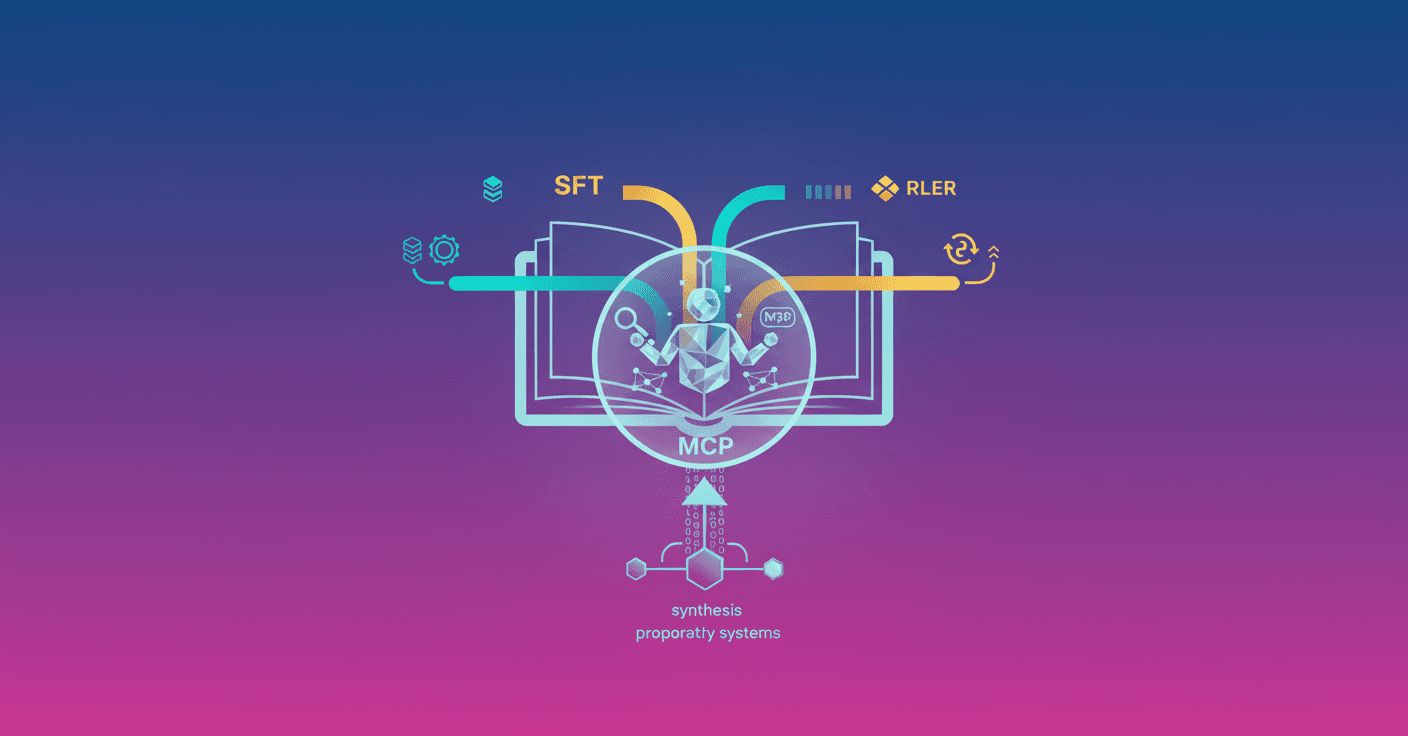
Ai2 has introduced DR Tulu, an open AI agent that searches for information, consults different sources and writes cited reports. Its 8-billion-parameter version, DR Tulu-8B, outperforms larger open systems in several tests and competes with proprietary agents from OpenAI, Google and Perplexity.
This is not a chatbot that responds on the first attempt. Faced with a complex question, the model decides what it needs to know, searches for information, reviews web pages or scientific papers, identifies gaps and adjusts its strategy before writing a final answer.
What makes DR Tulu different
Most AI systems are trained on answers with a clear solution, such as a math problem or a question whose answer can be compared with a known fact. That method works less well when you need to prepare a report on an open-ended topic and gather evidence from many sources.
To address this, Ai2 combines two stages:
- Supervised fine-tuning: the model learns to plan searches, use tools and cite sources from generated and filtered examples.
- Reinforcement learning with evolving rubrics: the system receives rewards based on quality criteria that change and adapt to each question.
A rubric is a list of conditions used to evaluate an answer. In this case, it is not a fixed template. It is generated with the help of searches specific to each query and can reward new, useful evidence or penalize problems such as copying text without synthesizing it, filling the report with irrelevant content or adding citations that do not actually support the claims.
This is meant to prevent a common flaw in these systems: learning to appear rigorous without actually being rigorous. A report can sound convincing and be packed with references while failing to connect the evidence properly or answer the question that was asked.
How the model researches
During execution, DR Tulu alternates between three actions:
- Thinking and planning the next step.
- Using a search or browsing tool.
- Writing the final answer with links to the sources that support its claims.
Ai2's setup includes three tools: web search, full-page content retrieval and scientific paper search. The system can make just a few queries for a simple question or many more when the topic requires comparing sources and exploring multiple lines of research.
The infrastructure uses the Model Context Protocol (MCP), a standard that connects external tools in a modular way. In practice, an organization could replace general searches with its own databases, internal search engines or document retrieval systems without retraining the model.
Results and cost
Ai2 evaluated DR Tulu-8B across seven benchmarks, four of them focused on long-form reports and synthesis from multiple sources. On ScholarQA-CSv2, it achieved a score of 86.7, compared with 42.5 for WebExplorer-8B and 32.9 for WebThinker-32B-DPO. It reached 71.1 on ResearchQA and 41.8 on DeepResearch Bench.
According to Ai2, it also outperformed the proprietary agents included in the comparison on ScholarQA-CSv2, including OpenAI Deep Research, with 79.6, and Perplexity Deep Research, with 67.3. On other benchmarks, it stayed close to several commercial systems, although the results depend on the task, the available tools and the configuration of each evaluation.
The model also stood out for being more compact. Its reports were approximately three times shorter than those from OpenAI Deep Research and used about half as many citations, with a similar score on one of the benchmarks. Ai2's interpretation is that the training favors more concentrated synthesis, not simply longer answers.
The reported cost needs context: it counts only calls to external APIs and assumes that the hardware and hosting have already been paid for. Under that condition, a typical query would cost approximately $0.00008, while the configured maximum of ten searches would raise the cost to around $0.0075. Ai2 compares those figures with roughly $1.80 per query for OpenAI Deep Research on ScholarQA-CSv2.
What this changes for you
The model and code are released under a permissive license, along with the curated data, training system, RLER implementation, DR Tulu-8B model and dr-agent-lib library.
This allows universities, companies and developers to:
- Run it on their own infrastructure.
- Connect it to private or specialized sources.
- Review what it searched for and which evidence it used.
- Adapt it for scientific research, document analysis or internal queries.
That does not mean AI can conduct research without supervision. In healthcare, for example, DR Tulu-8B scored 43.7 on HealthBench, ahead of other open models but still with significant room for improvement. Ai2 also tested the system on questions about genetic variants and treatments, where it showed better evidence synthesis than several competitors, although GPT-5 with OpenAI search achieved the highest overall score.
DR Tulu's importance lies less in whether a small model can replace every commercial agent and more in the fact that it makes the entire process public: data, tools, training, evaluation and costs. The next thing to watch will be whether other teams can reproduce its results and whether evolving rubrics continue to detect errors when the system is used in new domains and with less controlled sources.